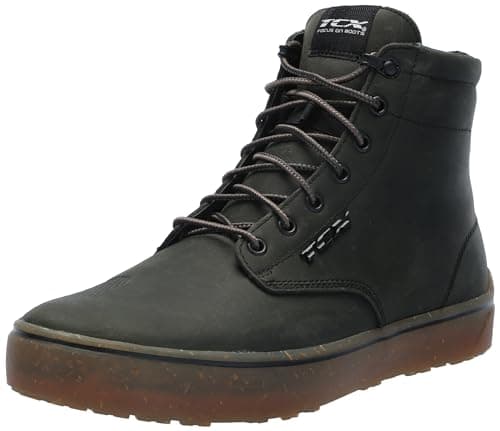
Everywhere else on this site we say the same blunt thing about footwear: sneakers have no ankle support, thin soles and materials that abrade instantly, and a real motorcycle bootis the answer. That is still true. But a great many riders commute in sneakers anyway, because a tall boot does not fit under work trousers, does not fit in a desk drawer, and does not get worn. A riding shoe is the gear industry's answer to that specific failure: a shoe shaped like a sneaker, built on a certified chassis, that you can ride in and then walk into a meeting wearing.
The catch is that "motorcycle shoe" is not a protected phrase. Search it and you get certified footwear from TCX, REV'IT!, Alpinestars and SHIMA sitting in the same results as $40 canvas sneakers with a moto logo printed on the tongue and nothing at all behind it. So the first filter on this page is binary: does the maker publish a CE EN 13634 certification for the shoe, in writing, on a page you can read? Everything ranked below does. Everything that does not was left off.
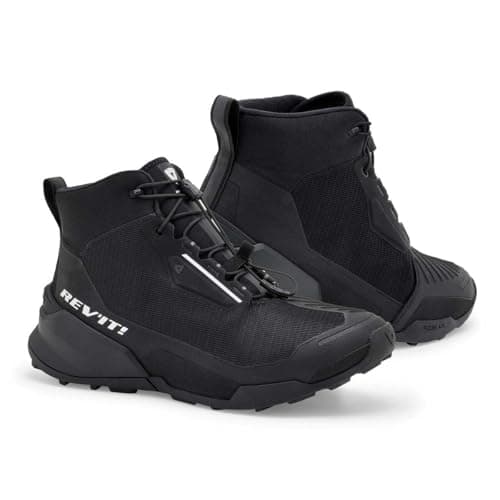
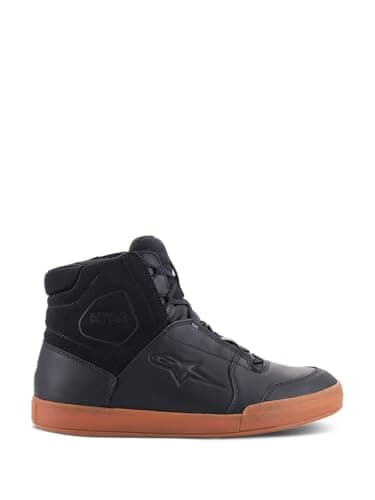
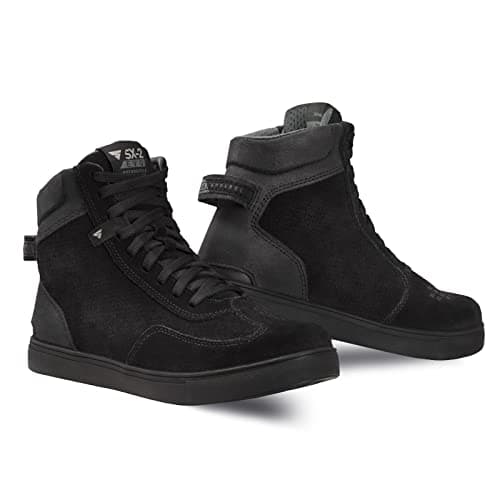
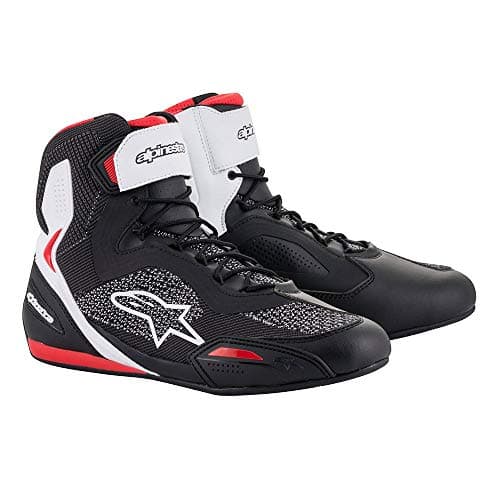
After that gate, we ranked on what the shoe actually does for you. The TCX Dartwood WP takes the top spot because it carries the most protective hardware — D3O ankle reinforcements and a ZPLATE midsole insert — behind a genuine waterproof membrane. The REV'IT! Subduction publishes the most specific certification on the page, an actual per-test level string, and gives up weather sealing to do it. The Alpinestars Chrome Drystar is the most coverage you can get and still call it a shoe. The SHIMA SX-2 EVO is the cheapest certified pair here and is refreshingly plain about scoring level 1 on everything. And the Alpinestars Faster-3 Rideknit is the one to buy if heat is what drives you back to sneakers.
One thing we will not do is pretend a shoe is a boot. Every pick here protects less than the tall boots in our main boots ranking, and the buying guide below is mostly about understanding exactly which protection you are trading away for the ability to keep your footwear on all day.
EN 13634 is a gate, not a grade
EN 13634is the CE standard for motorcycle footwear, and it does not produce one score. It rates four things separately — upper height, impact abrasion resistance, impact cut resistance and transverse rigidity(how hard the shoe is to crush from the side) — each at Level 1 or Level 2. Nearly every maker in this category prints "CE certified" and stops there, which is true and tells you almost nothing.
Two of the shoes here go further. REV'IT! publishes "Level 1 | 1 | 2 | 2 certified according to standard EN 13634:2017" for the Subduction, and SHIMA publishes "certified according to EN 13634:2017, protection level 1111" for the SX-2 EVO. Read in the standard's usual marking order, REV'IT's two Level 2 ratings fall on impact cut and transverse rigidity — though REV'IT itself does not label the digits, so treat that as our reading rather than the maker's claim. SHIMA's 1111 is the floor: a pass on every test at the lower level. Both are more useful to a buyer than a bare badge, and it is why the two most informative labels on this page sit at opposite ends of the price range.
The other thing worth knowing is how much of EN 13634 is optional. According to SATRA, the test house, the standard's core requirements cover design, whole-shoe tests such as bond strength and transverse rigidity, and component tests for things like tear strength and abrasion — while impact energy protection for the ankle and shin, resistance to water penetration, fuel-oil resistance, outsole slip resistance and breathability are optionalproperties. In plain English: a certified shoe has not necessarily been tested for ankle impact protection, and "certified" never means "waterproof." That is why the ankle hardware and the membrane get their own sections below instead of being folded into the certification.
Height is the protection you are trading away
Upper height is one of the four rated areas, and it is measured with a ruler from the heel to the top of the upper. No shoe reaches the tall class — that class is what a boot is for. A low-cut shoe therefore cannot brace the ankle joint the way an over-the-ankle boot does, and it protects none of the shin at all. Our short vs tall boots comparison runs that trade properly, and do you need motorcycle boots is the honest case for skipping this category entirely.
Within the shoes, the difference is still real. The Alpinestars Chrome Drystar is a high-top that sits above the ankle bone; the Faster-3 Rideknit is cut low like a running shoe. Both are certified. They do not cover the same amount of you, and if coverage is what you are shopping for, the cut of the shoe tells you more than the badge does.
The four things to check after the certification
Ankle hardware. Because ankle impact protection is optional under the standard, look for it by name: D3O ankle reinforcements on the Dartwood, SEESOFT discs on the Subduction, a dual-density ankle protector on the Chrome Drystar, ArmorPlus absorbers on the SX-2 EVO. A shoe with a certificate and no named ankle protection is protecting your ankle with fabric.
Something rigid in the sole.The injury a low shoe is most exposed to is your foot being twisted or crushed rather than cut. Every serious shoe here answers that with structure: TCX's ZPLATE midsole insert, REV'IT's FLEXBLADE, Alpinestars' TPF midsole plate and integrated support shank, SHIMA's transversely reinforced sole. If you can wring a shoe out like a dishcloth in your hands, that is what your ankle is working against.
Toe and heel reinforcement, and a shift pad. A reinforced toe box and heel counter take the load when a bike pins your foot, and a reinforced instep is what stops the shifter chewing through the top of the shoe in a single season. This is the detail that separates a riding shoe from a hiking shoe that happens to be black.
Sole grip and the lace problem. You are putting a foot down at a red light, often on diesel-slick pavement, holding up several hundred pounds of motorcycle. A wear- resistant rubber compound with a real tread pattern matters. So does what happens to your laces: loose laces catch on pegs and levers. A side zip, a quick-lace or a strap over the laces is a genuine safety feature, not a convenience.
Waterproof, vented, or neither
This is the decision that splits the page. The TCX Dartwood WP (T-DRY) and the Alpinestars Chrome Drystar (Drystar, published at 5,000 mm waterproofing and 5,000 g/m2 breathability) have real membranes and will carry you through a wet commute. The Faster-3 Rideknit and the SX-2 EVO are ventilated summer shoes with no membrane at all, and they are much better in heat because of it. The Subductionsits in the middle: no membrane in this version, though REV'IT! sells a separate H2O variant that adds one.
There is no shoe here that does both jobs well, and be suspicious of any that claims to. Membrane shoes run hot; mesh shoes wet through. If your riding is genuinely year-round, buying one membrane shoe and one vented shoe costs less than most single pairs of premium boots — or buy the waterproof shoe and read our waterproof boots ranking for the days the forecast is worse than a shoe can handle.
Where a shoe is the wrong answer
If you ride sport, tour long distances or go anywhere near dirt, buy boots. A riding shoe is for the commute, the coffee run and the city ride — the trips where the realistic alternative is not a boot but a sneaker. Used that way it is a large upgrade. Used as a substitute for real boots on a fast road, it is not.
It also does nothing above the ankle, which is worth remembering when you build the rest of the kit. Our commuting gear guide covers the all-weather side of the daily ride, and armored riding jeans are the natural companion to a riding shoe for exactly the same reason: they are the protective version of clothing you were going to wear anyway.
Which one should you buy?
Buy the TCX Dartwood WP if you want one pair that covers most of the year: it has the most named protection on the page and a membrane behind the leather. Buy the REV'IT! Subduction if the certification ladder is your deciding factor and you accept a dry-weather shoe to get the highest published levels here. Buy the Alpinestars Chrome Drystar if you want the most ankle coverage and the wettest-weather shoe, and the price does not scare you. Buy the SHIMA SX-2 EVO if the budget is real: it is certified, it publishes what it scored, and level 1 across the board is a great deal more than an uncertified sneaker. And buy the Alpinestars Faster-3 Rideknitif heat is the reason you keep reaching for sneakers — the airiest certified shoe here is the one that will actually be on your feet in August. Whichever you choose, our boot break-in guidecovers the one thing a knit shoe does not need — breaking in — and what to do with the boots that do, and our how to choose motorcycle boots guide takes the standard apart in more detail.