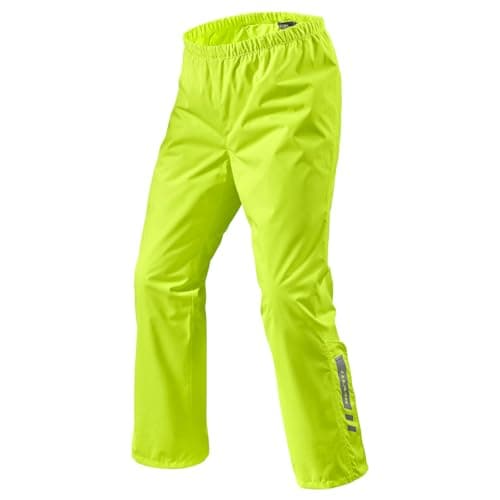
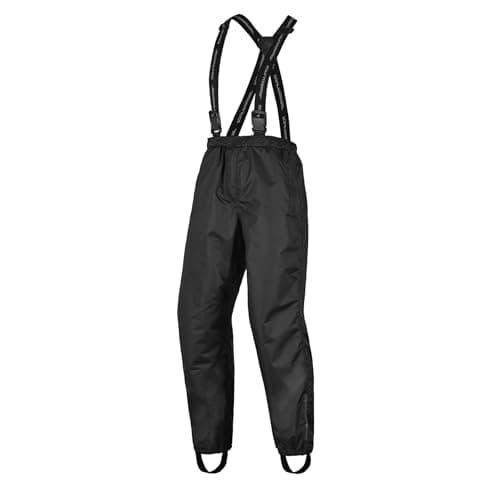
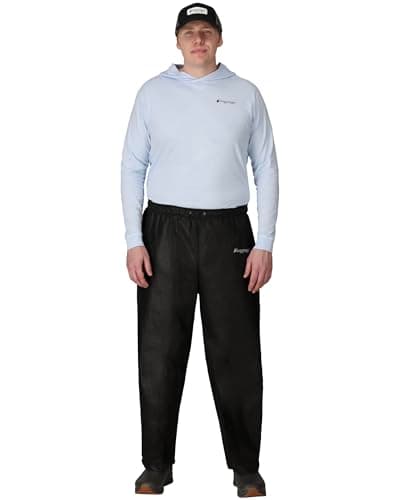
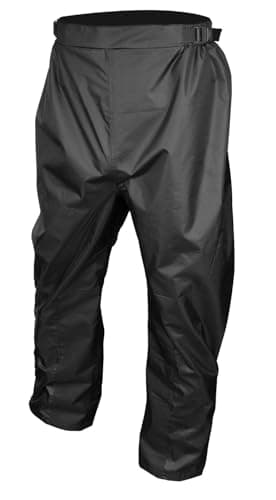
Buy the Nelson-Rigg Solo Storm. It publishes the two things that decide a rain pant — electronically taped seams and oversized zipper-free leg gussetsyou can actually get over a boot in the wet — and it is the only pant here with heat-resistant material on the lower legs for the moment your calf finds the exhaust. If you want a true laminate and the best sizing data, the REV'IT! Acid 4 H2O is the one; if you want the lightest thing that packs to nothing, the Frogg Toggs Pro Action weighs a published 17 ounces and costs the least.
First, the thing every page like this should say and most do not: a rain pant is not protective equipment. Nothing on this page carries an EN 17092 garment class or any abrasion rating, because that is not what a rain shell is for. These go over your real gear. If you are looking for armored legwear, our motorcycle riding pants ranking covers textile over-pants with CE armor and a published garment class, and our armored jeans ranking covers denim. Buying a rain pant instead of either of those is a downgrade, not a purchase.
With that settled, a rain overpant is a narrow product judged on narrow things. We ranked them on four, in this order:
- How is it waterproofed, and does the maker say the seams are sealed? Fabric almost never leaks. Seams do. A maker who says "waterproof fabric" and nothing about taping has told you the easy half. Two of these four state the seam construction outright.
- Can you get it on, over boots, standing at the side of a road? This is the feature riders underrate and then curse. A leg opening that will not clear a boot means taking the boot off on a wet verge, which is how rain pants end up unused in a pannier.
- What does it do for visibility? Rain is also the low-light, spray-covered-windscreen condition. Reflective material on the calves is worth more than reflective material anywhere else on a rider, because that is what moves.
- What does it cost you to carry? The best rain pant is the one in your luggage on the day it rains. Packed size and weight decide whether it is there.
We have not worn these in a storm, timed a leg zip or run a hydrostatic head test. Every specification below is quoted from the maker's or retailer's published page, each one linked at the bottom, and where nobody publishes a figure we say so rather than inventing one. Prices move, so no numbers appear in the prose — the live price and the date we checked it sit on every buy row above.
The four pants, side by side
| Pant | Waterproofing | Seams | Over-boot entry | Published weight |
|---|
| Nelson-Rigg Solo Storm | Polyester oxford, PU backing | Electronically taped | Oversized zipper-free gussets | Not published |
| REV'IT! Acid 4 H2O | Laminated hydratex|Lite | Not published | Not published | Not published (carrier bag included) |
| Tourmaster Sentry Evo | Laminated | Fully seam-sealed | Elastic cuffs + stirrup straps | Not published |
| Frogg Toggs Pro Action | DRIPORE GEN2, 3,000 MVTR | Not published | Oversized hook-and-loop openings | 17 oz |
Seams are where rain pants fail
Every fabric on this page keeps water out. That is the easy part, and it is why makers talk about it. What decides whether you arrive dry is what happens at the needle holes: every stitch is a hole through the waterproof layer, and a pant with a perfect membrane and raw seams will wet through at the crotch and the inner thigh inside an hour.
Sealing them means bonding a tape over the seam from the inside, with heat or with high frequency welding. Nelson-Rigg states that all seams are electronically taped and calls the result 100% waterproof. Tourmaster states a laminated, fully seam-sealed design. Those are checkable claims, and they are a large part of why those two finish first and third. REV'IT! and Frogg Toggs describe their fabrics in detail and say nothing about seam construction, and we rank them on exactly that.
One honest caveat applies to all four: nobody here publishes a hydrostatic head figure in millimeters, and only Frogg Toggs publishes a breathability number (3,000 MVTR). So you cannot rank these on membrane performance the way you can rank a jacket. You can only rank them on construction, which is what this page does.
Coating or laminate, and why it matters less here
On a riding jacket, laminate versus drop liner is a real decision. On a rain shell the stakes are lower, but the difference still shows up. A laminatebonds the waterproof layer to the face fabric, so the shell never wets out and stays the same weight all day — REV'IT! uses hydratex|Lite this way and Tourmaster describes a laminated construction. A coating, like the polyurethane backing on the Nelson-Rigg, is sprayed or rolled onto the inside of the fabric; it is cheaper, heavier, less breathable, and in a long downpour the outer face soaks and gets cold.
For a garment you wear for two hours in the rain and then take off, that trade matters much less than it does on a jacket you live in. It is a real reason to prefer the REV'IT! if you ride long wet days, and not a reason to pass on the Nelson-Rigg otherwise. Our waterproof jackets ranking goes much deeper on membrane construction, where it genuinely decides the purchase.
The lay-by test: getting them on
Here is the scenario every rain pant is really designed for. It has started raining harder than forecast. You are on a verge, in boots, in gloves, with traffic going past. You need the pant on in under a minute without sitting in wet grass or taking a boot off.
That is a leg-opening problem, and the pants divide sharply on it. The Nelson-Rigg publishes oversized zipper-free self-fastening leg gussets— they open wide, there is no zip to jam on wet fabric, and they close on themselves. The Frogg Toggs uses oversized hook-and-loop leg openings for the same reason. Neither REV'IT! nor Tourmaster publishes a leg zip or gusset at all; the Tourmaster relies on an elastic cuff stretching over the boot and adds a stirrup strap underneath to stop the leg riding up afterwards.
If you ride in tall adventure or touring boots, weight this heavily. Our adventure boots ranking and waterproof boots ranking cover the boots in question, and the taller the shaft the more a wide gusset is worth.
The rule that undoes all of this
Put the rain pant leg overthe boot, never inside it. A trouser leg tucked into a boot is a funnel: every drop that lands on your thigh runs down the inside of the fabric and collects in the boot, which cannot drain. Riders do this because it looks tidier and because the leg flaps otherwise — which is exactly what the Tourmaster's stirrup straps and the Nelson-Rigg's self-fastening gussets exist to solve. Our wet-weather gear guide covers the other four places water gets in, and the one that actually ends rides: a fogged visor.
The exhaust, and why one pant here thinks about it
A thin synthetic rain pant and a hot exhaust are a bad combination, and it is the failure mode nobody warns you about: a moment's contact on the lower leg melts a hole straight through, usually on the first or second wearing. Only Nelson-Rigg addresses it, with heat-resistant material on the lower legs for brief contact with hot parts. That is a genuinely motorcycle-specific feature and it is the clearest single reason this pant finishes first.
It is also the strongest argument against the Frogg Toggs for riders, and we would rather say so plainly than pretend otherwise: nonwoven polypropylene is a camping fabric. It keeps rain out beautifully, it weighs almost nothing, and it has no business near a header pipe.
Suit or separates?
Every pant here is sold alone, and most makers also sell a matching jacket or a complete two-piece rain suit. Separates are usually the better buy for a rider who already owns a waterproof jacket — which, if you bought from our waterproof jackets ranking, you do. A full suit makes sense when your riding jacket is a mesh or unlined textile shell with no membrane at all, because then you need both halves and buying them together is cheaper.
Either way, size the pant to go overthe trousers you actually ride in, not over your jeans. All four here are cut loose for that, and REV'IT! is the only one publishing hip and inseam measurements per size so you can check rather than guess.
Which should you buy?
Buy the Nelson-Rigg Solo Storm if you want the most complete published package for a motorcycle: taped seams, gussets that clear a boot, heat-resistant lower legs, a reinforced seat panel and sizes to 4XL. Buy the REV'IT! Acid 4 H2O if you ride long wet days and want a true laminate that will not wet out, plus the only published per-size measurements here. Buy the Tourmaster Sentry Evo if you want a seam-sealed laminate from a moto brand with 3M reflective and stirrups at a sensible price. And buy the Frogg Toggs Pro Actiononly as a packable emergency layer you keep in the luggage — it is the lightest and cheapest way to stay dry, and the least durable thing on this page. Whatever you choose, our gear checklist has the rest of the wet-weather kit.