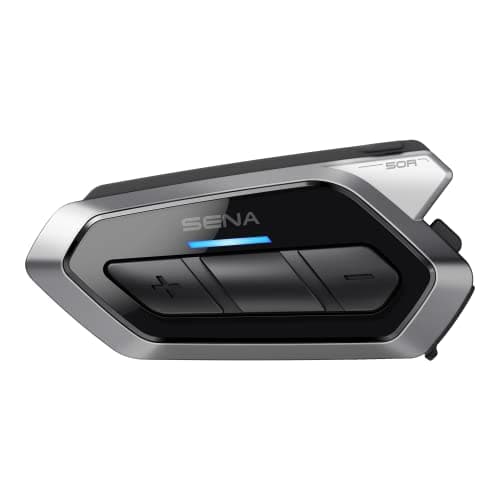
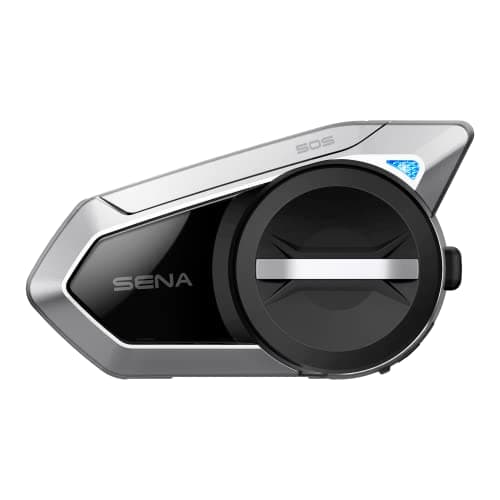
The 50S and the 50R are the same intercom in two different housings, and Sena's own specification tables make that unusually easy to check. Both are listed with Mesh Intercom 3.0, both carry Sound by Harman Kardon with 40mm drivers 7.2mm thick, both run Bluetooth 5.0 with Advanced Noise Control and a built-in FM radio, and both publish a Bluetooth intercom working distance of up to 2 km / 1.2 miles in open terrain, Group Mesh for up to 24 riders and six Open Mesh channels.
What differs is the body, and the battery numbers that follow from it. The 50S is the jog-dial unit: a rotating wheel you can find and turn in thick gloves without looking, in a housing that stands proud of the shell. Sena publishes 16 hours of Bluetooth intercom talk time and 13 hours on Mesh. The 50R is the low-profile three-button unit, and Sena publishes up to 13 hours Bluetooth and up to 11 hours Mesh — roughly three hours less on each.
There is one figure that runs the other way, and it is the most interesting number on either page. Sena's quick-charge spec for the 50S is 20 minutes of charging for 2 hours of Bluetooth intercom or 2 hours of Mesh. For the 50R it is 20 minutes for 6 hours of Bluetooth intercom or 3.5 hours of Mesh. The 50R has the smaller battery and the far better top-up. If your riding day includes a coffee stop, the 50R's shorter runtime stops being a problem.
Worth flagging honestly: Sena has moved the flagship slot on to the 60 Series, so both of these are previous-generation units — which is exactly why they are worth looking at, since Sena has kept them current with Mesh Intercom 3.0 rather than abandoning them. Our mesh intercom ranking covers where they sit in the wider field.
The jog dial is not a gimmick
Sena's jog dial gets described as a styling choice and it is not. It is the one control on a helmet intercom you can operate with a winter gauntlet on, at speed, without taking your eyes off the road: rotate for volume, press for the obvious action. Buttons require you to find a specific small target by feel and get it right first time. In a summer glove, the difference is small. In a heated glove or a thick winter gauntlet — the conditions that make an intercom worth having in the first place — the difference is real.
The 50R answers with a housing that sits far closer to the shell. If you ride a full-face with a tight cheek profile, if you have had a bulky unit catch on a jacket collar, or if you simply do not want a visible box on the side of your helmet, the low profile is a legitimate reason to choose it. That is a fit-and-feel decision, not a performance one, and nobody can make it for you from a spec sheet.
The battery numbers, read properly
Published talk time is a laboratory-style figure, and real runtime depends on volume, how much you actually talk, temperature and whether music is streaming the whole way. Treat the numbers as a ratio rather than a promise: the 50S has roughly a quarter more capacity than the 50R on both Bluetooth and Mesh.
Then apply the quick-charge figures, because they change the answer. For a rider doing a long day with stops, the 50R's 20-minutes-for-6-hours Bluetooth top-up is worth more than the 50S's extra three hours of raw runtime. For a rider doing one uninterrupted long haul with no chance to plug in, the 50S is the safer unit. Cold weather cuts every lithium battery's real output, so if you ride through winter, size up rather than down — the same logic we apply in our cold-weather gear guide.
Mesh 3.0 on a previous-generation unit
Sena currently lists both the 50S and the 50R with Mesh Intercom 3.0, Group Mesh for up to 24 riders and six Open Mesh channels. This matters for a reason that has nothing to do with features: it means both units are still being maintained. An intercom is a piece of networked software as much as a piece of hardware, and a unit whose mesh stack stopped getting updates will eventually stop playing nicely with the units your friends buy next year.
Same caveat as always, and it is the one that costs people money: Sena Mesh and Cardo DMC are separate networks and do not interconnect. Buy the brand your riding group already runs. If you are starting a group from scratch, our Cardo vs Sena comparison is the place to make that call.
Which one should you buy?
Buy the 50S if you ride in thick gloves, ride in the cold, or want the longest published runtime of the pair. The jog dial is the better interface for the conditions where an intercom actually matters, and the extra battery is a genuine margin.
Buy the 50R if you want the slimmest unit on the shell, if you mostly ride in warm weather in thinner gloves, or if your days include stops — the quick-charge specification is dramatically better and effectively erases the runtime gap. Whichever you pick, wear plugs under the helmet: our earplug ranking explains why that makes the speakers sound better rather than worse.