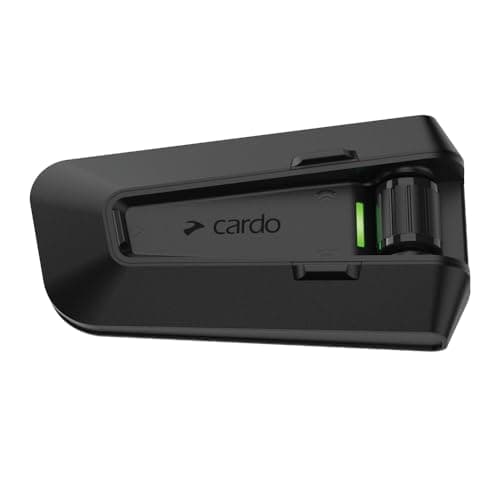
How this review was made, stated plainly:we have not ridden with a Packtalk Pro, we do not have a test unit, and we have not measured its audio, range or battery. What follows is a review built from Cardo's published specifications, the feature set the company documents, and the way this unit compares against its siblings on the same published figures. Where we have no verified information, we say so instead of filling the gap. If you want a review from someone who has lived with one for a season, go and find one — this is a different and complementary thing, and it is honest about which it is.
The Packtalk Pro sits at the top of Cardo's range, above the Edge and the Neo. It shares their core: Dynamic Mesh Communication, Natural Voice Operation, over-the-air updates through the Cardo Connect app, and a waterproof body. What it adds over them is the 45mm JBL speaker set — the largest driver hardware in Cardo's line — and the Pro-specific features Cardo markets it on.
The short verdict: if comms is genuinely a priority for you and you ride in a group, this is the most capable thing Cardo sells and the speaker hardware is a real, published difference rather than a badge. If you ride alone, or two-up with a passenger, it is more unit than the job needs, and the money is better spent elsewhere — probably on your helmet, which does more for your audio than any speaker upgrade.
What Cardo publishes, and what it means
The Packtalk line as a whole is built on DMC — Dynamic Mesh Communication — which is the feature that separates a serious group intercom from a cheap one. A Bluetooth intercom links riders in a chain; drop one rider out of range and the riders behind can lose their connection. A mesh network is self-healing: riders join, leave and fall behind without anyone re-pairing anything, and the network routes around the gap. Across the Packtalk range Cardo publishes groups of up to 31 riders at a range of up to 1.6 km / 1 mile between riders.
The Pro's headline hardware difference is the 45mm JBL speaker set, against the 40mm JBL set on the Edge and the Neo. On a helmet speaker, driver diameter is the most honest proxy for output capability available to us: a larger driver moves more air and needs less excursion for a given volume, which usually means more low end and less strain. We have not measured it. Cardo publishes it, and it is a real difference in hardware rather than a marketing tier.
Natural Voice Operation is the other feature that changes daily use. You speak, the unit responds; you are not hunting for a button at 70 mph in gloves. How well voice control works depends heavily on how much wind noise reaches the microphone, which means it performs better in a quiet full-face than in an open shell — a caveat that applies to every voice-controlled intercom, not just this one.
Who this unit is actually for
Buy it if you ride in a group of four or more, regularly, and the group is on Cardo. Mesh is the entire value proposition and mesh does not cross brands — Cardo DMC and Sena Mesh are separate networks. A flagship unit that cannot join your friends' group is worse than a cheap one that can. This is the most expensive mistake available in this category and it is entirely avoidable: ask what your riding group runs before you buy.
Buy it if audio quality is a specific priority and you have already dealt with the bigger variables — a quiet helmet, plugs in, speakers positioned properly in the ear pocket. In that order the 45mm set is a genuine upgrade. Out of that order, it is an expensive way to get slightly louder wind.
Who should skip it
Skip it if you ride solo. A solo rider wants music, calls and turn-by-turn directions, and every unit in our budget intercom ranking does all three. Mesh networking for one person is a feature you are paying for and will never use.
Skip it if you ride two-up. A rider and a passenger are a two-device link eighteen inches apart — the hardest problem in intercom design is not present. The Spirit HD or the Sena 5S covers that job properly for a fraction of the money.
Skip it if your riding group is on Sena. Buy Sena instead, and buy the best Sena you can afford — our 50S vs 50R comparison is the place to start.
What we could not verify
In the interest of not padding: we have no independently verified figure for real-world battery life on this unit, no measured audio performance, no measured range under obstruction, and no long-term reliability data. Cardo's published claims are linked in the sources below and we have quoted them as claims. If any of those unknowns is the deciding factor for you, a hands-on long-term review is the right source and we would rather point you at one than pretend we are it.
What we are confident saying, because it follows from published specifications rather than from testing: this is the top of Cardo's range, the speaker hardware is genuinely larger than its siblings', the mesh is the same DMC the whole Packtalk line runs, and the decision that should drive your purchase is which network your friends are already on.