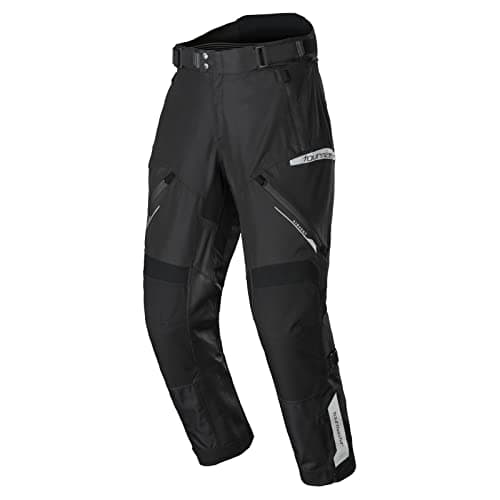
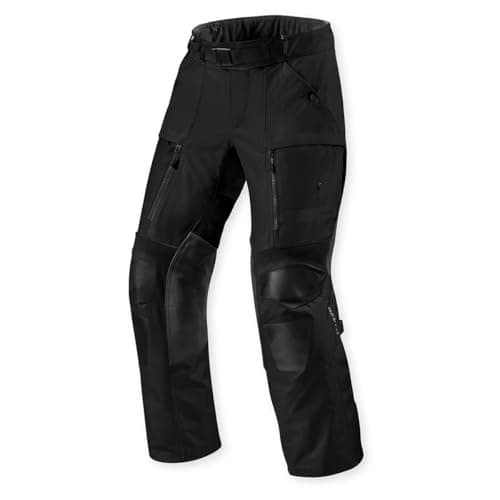
If you want one pair of riding pants and you want the maker to have documented them, buy the REV'IT! Sand 5 H2O. It is the only pant here that publishes a garment class and ships certified armor at both joints: approved to EN 17092-3:2020 as a CE Class AA garment, with SEEFLEX CE Level 2 knee armor and SEESMART CE Level 1 hip armor in the box. If that is more money than the job is worth, the Tourmaster Mariner Laminatedis a real laminate with Level 2 knee armor for well under half the price — as long as you accept EVA foam at the hip.
Legwear is the gap in almost every rider's kit. People buy a certified helmet, a certified jacket, gloves and boots, and then put all of it on over denim. That is understandable and it is also the one remaining place where a slide puts bare skin on tarmac, because the hip and the knee are the two points that hit first when a bike goes down and slides. This page ranks textile over-pants: the pants you pull on over normal clothes or wear as your outer layer. If you want something you can walk into an office in, our armored motorcycle jeans ranking is the denim equivalent and a different list.
We ranked riding pants by asking four questions, in this order:
- What garment class does the maker publish, and does it name the standard and the year? EN 17092rates the whole garment — fabric, seams and panel zoning — and sorts it into AAA, AA, A, B or C. It is the only published evidence of how the trouser resists abrasion. Two of these four publish a class. Two do not, and the ranking says so.
- What armor is actually in the box, at which joint? This is where riding pants quietly differ from riding jackets. A jacket almost always ships with shoulder and elbow armor; a pant very often ships with knee armor and an empty hip pocket. Only one pant here includes a certified hip protector.
- Laminate or liner, and does the maker publish the construction? A laminated shell never soaks up water and has nothing to zip in or out; a liner system can be stripped to a vented shell in summer and built back up in winter, at the cost of carrying the pieces.
- Can you survive a hot day in them? Legs sit directly behind the engine and out of the airflow. Vent count and placement matter more on pants than most riders expect, and the pant you cannot stand in August is the pant that stays in the garage.
We have not crash-tested these pants, abraded a panel or run a lab. Every specification below is quoted from the maker's or retailer's published spec sheet, every source is linked at the bottom, and where a maker publishes nothing we say so instead of guessing. Prices move constantly, so we do not write numbers into the prose — the live price and the date we last checked it sit on every buy row above.
The four pants, side by side
These are the published figures in the makers' and retailers' own terms. Where a cell says "not published," that is the honest state of the spec sheet.
| Pant | Garment class | Knee armor | Hip armor | Waterproofing |
|---|
| REV'IT! Sand 5 H2O | EN 17092-3:2020 Class AA | SEEFLEX CE Level 2 | SEESMART CE Level 1, included | Detachable Hydratex 3L liner |
| Tourmaster Mariner | Not published | Armanox CE Level 2 | EVA foam, not certified | 450D Cordura laminate, seam-sealed |
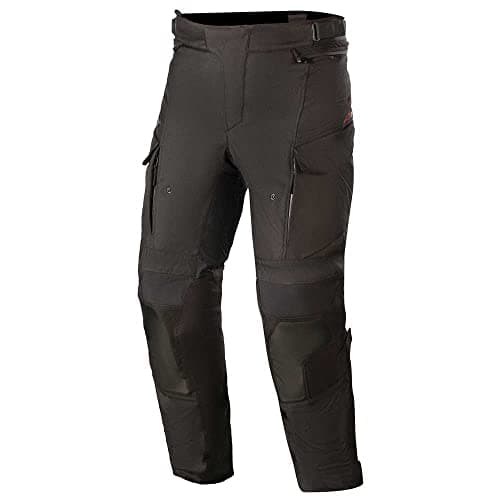
| Alpinestars Andes v3 | EN 17092 Class A | Bio Flex CE Level 1 (EN 1621-1:2012) | Pockets only, sold separately | Drystar membrane |
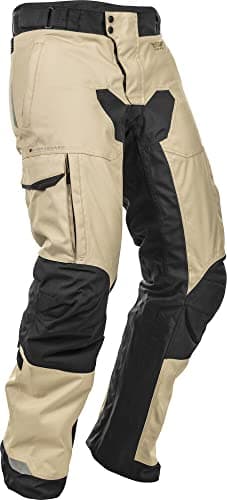
| FLY Racing Terra Trek | Not published | CE Level 1 (EN 1621-1) | Pockets only, sold separately | Hydraguard, fully taped seams |
The hip is the zone the industry quietly skips
Read that table again and look at the hip column. One pant out of four arrives with a certified hip protector. One fits uncertified foam. Two ship an empty pocket and sell you the protector separately.
That matters more than it sounds, because the hip is not an afterthought joint on a motorcycle. When a bike slides out from under you, the sequence is usually hip first, then knee, then whatever the bike does next. A hip fracture is one of the injuries most likely to put an older rider in hospital for a week rather than an afternoon. An empty pocket is not protection, in exactly the way the foam pad in the back of a cheap jacket is not a back protector — a point our back protector guide makes at length about the other end of the torso.
The practical move, if you buy one of the three pants that does not include it, is to budget for the hip insert at the same time rather than "next month." Both Alpinestars and FLY sell a matching piece for their own pockets, which is the safest route because a protector has to fit the pocket it goes in. Our CE armor levels guide explains what Level 1 and Level 2 actually mean before you spend.
Class AA, Class A, and no class at all
EN 17092 is the garment standard, and it is separate from the CE level on the armor inside. AAA is the top class, built for sport and fast touring. AA is the strong all-round road class. A is lighter protection, common on hot-weather and urban gear.
REV'IT! publishes "approved to EN17092-3:2020 as a CE Class AA garment" and Alpinestars publishes "CE approved to EN17092 as a Class A garment." Those are checkable claims, and they are the reason those two pants finish first and third. Tourmaster and FLY publish no class. Both name their armor standard, and FLY goes further than anyone on fabric by publishing a 600D shell with 1680D at critical wear areas — but a denier is a yarn weight, not a test result, and an armor level says nothing about the trouser around it. We rank both on what is documented and no higher.
One honest note on the top of the table. The REV'IT! is Class AA, not AAA. Nothing on this page is AAA, because AAA textile legwear is overwhelmingly one-piece race kit and heavy adventure gear well outside what these four are for. If you ride a sportbike hard on track days, you want leather, and that is a different purchase entirely.
Laminate or liner: pick by how your weather behaves
A laminate bonds the waterproof membrane to the outer fabric, so the shell itself never wets out. The pant stays the same weight in hour three of rain as it was in minute one, dries quickly, and there is nothing to zip in or out. The Tourmaster Mariner is the laminate here, and Tourmaster backs it with electronically seam-sealed construction and a DWR coating. The cost of a laminate is that your only heat adjustment is the vents.
A liner systemputs the membrane in a layer you can remove. The REV'IT! runs two detachable liners — a Hydratex 3L waterproof layer and a separate thermal layer — which is why one pant covers a wet October commute and a cold January one. Alpinestars uses a fixed Drystar membrane with a removable thermal liner, which is the middle road: always waterproof, warmth optional. FLY's Hydraguard is described as a windproof, waterproof, breathable construction with a removable thermal liner, though FLY does not say whether the membrane is laminated or a drop liner.
If you ride year-round in a climate with real seasons, the liner systems win on range. If your problem is specifically rain and a lot of it, the laminate wins on behaviour. Our rain gear guide covers the rest of the wet-weather kit, including the one legwear mistake that undoes all of this: tucking the trouser leg into the boot, which turns it into a funnel.
Ventilation, and why legs are the hard case
Your legs sit behind the fairing, beside a hot engine and largely out of the airflow that cools your chest. A jacket with the vents open feels different at 50 mph; a pair of waterproof pants with no vents feels the same as it did at a standstill, which is to say unbearable.
The Tourmaster publishes the best answer on this page: large vertical zippered air vents on the front andback of the thigh, which is unusual and genuinely effective because it gives the air somewhere to leave. Alpinestars publishes direct ventilation ports on the thighs plus zippered thigh vents. FLY publishes intake and exhaust vents without a count. REV'IT! publishes zippers at the upper legs, the shortest vent list here — which is the trade for being the most certified pant on the page. If you ride through real summers, weight that column heavily; if you mostly ride spring and autumn, it barely matters. The same logic applies at the other end of the body, where airflow is even harder to compare — our ventilated helmets ranking covers what helmet makers actually publish about their vents.
Fit, and the two adjustments that decide it
Riding pants have a fit problem jackets do not: the knee armor has to stay over your kneecap while your leg is bent at roughly ninety degrees on the pegs, not while you are standing in a bedroom. Two features address this, and both are worth paying for.
The first is adjustable knee armor height. The REV'IT! and the Tourmaster both publish three-position adjustable knee armor, and the Alpinestars has adjustable knee protector pockets. If your inseam is unusual in either direction, this is the feature that makes the armor land correctly.
The second is length choice. REV'IT! sells short and long inseams two inches either side of standard on most sizes; FLY sells Regular and Tall from US 30 to 40; Alpinestars runs 2XS to 6XL. Buy the length that puts the armor on the joint, then adjust. Sit on the bike before you cut the tags off, exactly as our jacket fit guide recommends for the upper body: the riding position is the only position that counts.
Which pants should you buy?
Buy the REV'IT! Sand 5 H2O if you want the most documented legwear here and the only pant that arrives ready to ride: Class AA, Level 2 at the knee, Level 1 at the hip, two detachable liners and the widest inseam choice. Buy the Tourmaster Mariner Laminatedif rain is your main enemy and the budget is real — a seam-sealed 450D Cordura laminate with Level 2 knee armor and the best venting on the page, as long as you plan to live with foam at the hip. Buy the Alpinestars Andes v3 Drystar if you want a published garment class, a genuine all-season membrane and the widest size range, and you will add the hip armor yourself. And buy the FLY Racing Terra Trek if your riding leaves the pavement and you want the toughest published fabric here, accepting that FLY tells you nothing about the garment as a whole.
Whichever you choose, finish the kit the same way: our jackets ranking, boots ranking and knee armor ranking cover the pieces that sit next to these, and our gear checklist is the full list.