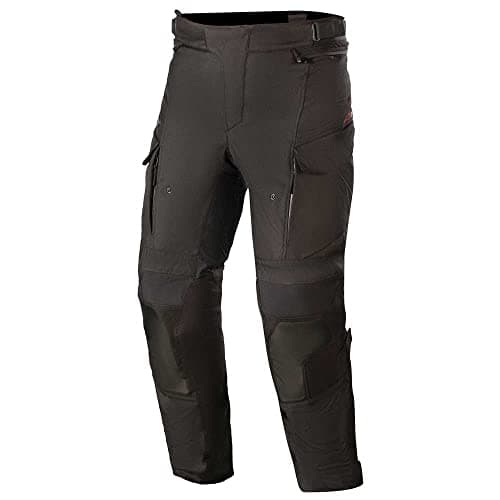
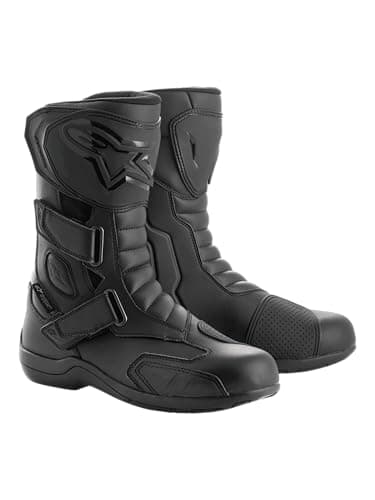
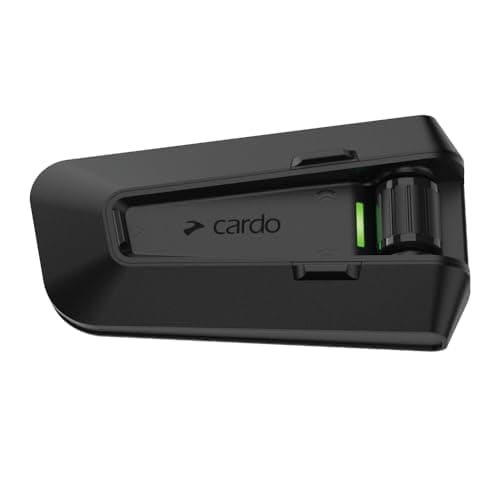
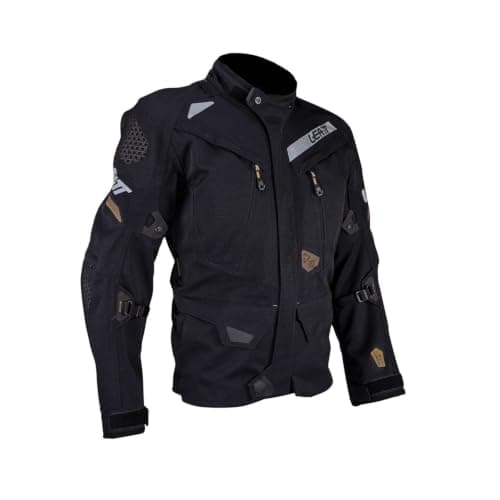
If you are building a kit for long days, start with the Leatt ADV DriTour 7.5 jacket: it is the most completely specified garment we rank, published as Class AA to EN 17092-3, with Level 2 armor at the back, shoulders, elbows and chest in the box and a laminated shell Leatt rates at 35,000 mm waterproof and 15,000 g breathable. It is for the rider doing multi-day distance in weather they cannot choose. Add the Alpinestars Andes v3 Drystar pants, a pair of Alpinestars Radon Drystar boots and a Cardo Packtalk Pro, and the four of them cover the four things that actually decide whether day three is enjoyable or endured.
Long-distance gear is chosen on a different basis from everything else on this site, and it is worth saying why. For a commute you optimize for getting in and out of it. For a track day you optimize for the crash. For distance you optimize for hour seven — for what a seam does to your collarbone after 400 miles, for whether you can get a layer off at a gas stop without unpacking the bike, for whether a membrane that was fine at 9 a.m. is still breathing at 4 p.m., and for whether you can hear a navigation prompt over the wind. Protection is the floor, not the differentiator. Everything below is certified; the ranking is about living in it.
The five things that decide a long-distance kit
- Weather range, not weather resistance.A trip crosses conditions. What matters is how far one garment stretches: vents that actually move air, a liner that comes out in ninety seconds at a gas stop, a laminate that does not need a cover layer. Leatt publishes real numbers for its shell — a hydrostatic head and a breathability figure — which almost nothing in this category does.
- Armor that is in the box and in the right place. A jacket advertised as armor-ready with empty pockets is a jacket you will ride in unprotected for the first month. The Leatt ships certified protectors in every zone including the chest; the Andes pants ship CE Level 1 knee armor to EN 1621-1:2012 and leave the hip pockets empty, which our riding pants ranking covers in detail and which is worth fixing before you leave.
- Boots you can walk in at the other end. A distance boot has to be protective, waterproof and tolerable off the bike, because a long trip includes fuel stops, motels and standing around. The Radon is a certified waterproof boot with dual-density ankle protectors, a Drystar membrane and three lateral adjustment straps.
- Comms, which is a comfort item on a long ride.Navigation prompts, music, a passenger and a riding partner all reduce fatigue. The Packtalk Pro's self-healing DMC mesh and JBL speakers are the benchmark; if you ride alone and only want navigation, a simpler unit from our budget intercom ranking saves real money.
- Hearing protection, which almost nobody packs.Eight hours of wind noise is genuinely fatiguing and cumulatively harmful. Earplugs are the cheapest fatigue-reduction purchase in motorcycling — our wind noise guide explains why and our earplugs ranking covers the published numbers.
We have not ridden any of this gear across a continent. Every certification, membrane and armor claim below is the maker's own published specification, linked at the bottom and scored against our published rubric.
The short answer
| # | Product | Best for | Score | Price |
|---|
| 01 | Leatt ADV DriTour 7.5The most complete published spec sheet on this page at a mid-range price: Class AA to EN 17092-3, Level 2 armor at the back, shoulders, elbows and chest all in the box, and a direct-laminated shell Leatt actually rates, at 35,000 mm waterproof and 15,000 g breathable. | Best adventure jacket overall | | $461.30·Amazon |
| 02 | Alpinestars Andes v3 Drystar PantsThe all-season commuter answer and the widest size range on the page: CE approved to EN 17092 as a Class A garment, with Bio Flex CE Level 1 knee armor certified to EN 1621-1:2012. The hip pockets ship empty. | Best all-season commuter pant | | $215.94·Amazon |
| 03 | Alpinestars Radon DrystarThe certified waterproof default: CE certified to EN 13634:2010 with a Drystar membrane, dual-density ankle protectors and a TPU shin plate — a real protective boot that happens to also keep the rain out. | Best waterproof boot overall | | $259.95·Amazon |
| 04 | Cardo Packtalk ProThe flagship. Cardo's self-healing DMC mesh keeps a big group connected, the JBL speakers are the best sound in the category, and natural-voice control means you barely touch the unit. If comms is a priority, this is the one. | Best overall / groups | | $449.95·Amazon |
#ad · Live prices from the Amazon Product API, as of October 19, 2026. Where we have no verified live price we show none — we would rather leave a gap than print a number that has rotted.
In detail
Best adventure jacket overall
EN 17092-3 Class AALevel 2 back, shoulder, elbow + chest includedLaminate 35,000 mm / 15,000 g5-year warranty
The most complete published spec sheet on this page at a mid-range price: Class AA to EN 17092-3, Level 2 armor at the back, shoulders, elbows and chest all in the box, and a direct-laminated shell Leatt actually rates, at 35,000 mm waterproof and 15,000 g breathable.
- Protection
- 9.6
- Weather range
- 9
- Comfort/fit
- 8.2
- Features
- 8.6
- Value
- 8.8
Pros
- +Leatt publishes the garment class, the standard and its year: EN 17092-3-2020, Class AA tested and certified
- +The only jacket here that ships with certified armor in every zone, including a Level 2 chest protector to EN 1621-3, and a Level 2 back protector to EN 1621-2
- +The only maker here to put a number on the membrane: 35,000 mm waterproof and 15,000 g/m2 breathable, on a direct-laminated ripstop shell with Superfabric on the impact zones
- +Removable thermal liner that Leatt says works as a standalone insulated jacket, and a 5-year warranty, the longest on the page
Cons
- −Leatt lists ventilation zippers on the chest and a mesh back panel, a shorter vent list than KLIM's, so it is not the jacket for the hottest days
- −Leatt publishes no fabric denier for the main shell, only the laminate construction and the Superfabric overlays
- −A laminate cannot be unzipped out on a hot afternoon; heat is managed by vents and by removing the liner
- −No hydration compartment is listed, where KLIM and REV'IT! both name one
Don't buy this if…
…most of your adventure riding is in real heat: the Tourmaster is a mesh shell and the REV'IT! can shed its waterproof layer entirely.
Best all-season commuter pant
EN 17092 Class A garmentBio Flex CE L1 knee to EN 1621-1:2012Hip armor optional, sold separatelyDrystar membrane + removable thermal liner
The all-season commuter answer and the widest size range on the page: CE approved to EN 17092 as a Class A garment, with Bio Flex CE Level 1 knee armor certified to EN 1621-1:2012. The hip pockets ship empty.
- Published certification
- 8.8
- Armor included
- 7.4
- Weather range
- 8.8
- Fit/adjustment
- 9.2
- Value
- 8.6
Pros
- +Alpinestars publishes the class and the armor standard by number: CE approved to EN17092 as a Class A garment, with Bio Flex knee armor certified CE Level 1 to EN1621-1:2012
- +Waterproof Drystar breathable membrane with a removable full-length thermal liner, so one pant covers most of the year
- +Direct ventilation ports on the thighs plus zippered thigh vents - Alpinestars describes them as giving high levels of airflow
- +Adjustable, removable bib braces, an adjustable waist with buckle and stretch material, and adjustable knee protector pockets
- +The widest published size range here, 2XS through 6XL, and a women's Stella version on the same platform
Cons
- −Class A is the lower road class: the REV'IT! on this page publishes Class AA, which is a stronger abrasion result
- −Hip armor is not included - the pant has pockets for optional Bio Flex hip armor, sold separately, so budget for it
- −Knee armor is CE Level 1 where the REV'IT! and Tourmaster both publish Level 2 at the knee
- −Alpinestars does not publish a fabric denier for the shell, only the membrane and the garment class
Don't buy this if…
…you want the hip protector in the box: Alpinestars ships empty hip pockets here and the REV'IT! does not.
Best waterproof boot overall
CE EN 13634:2010Drystar membraneDual-density ankleTPU shin plate
The certified waterproof default: CE certified to EN 13634:2010 with a Drystar membrane, dual-density ankle protectors and a TPU shin plate — a real protective boot that happens to also keep the rain out.
- Protection
- 9
- Fit/comfort
- 8.2
- Weather
- 9.6
- Walkability
- 7.4
- Value
- 8.4
Pros
- +Published CE EN 13634:2010 certification — not just a waterproof claim
- +Drystar waterproof and breathable membrane sits between the upper and the lining
- +Dual-density ankle protectors on both sides, plus a TPU shin plate and shift pad
- +Three lateral hook-and-loop straps let you dial the closure around your calf
Cons
- −Microfiber upper does not develop the character of leather
- −Stiffer to walk in than a touring boot with a softer sole
Don't buy this if…
…you want a boot that passes for street footwear off the bike — this looks like what it is.
Best overall / groups
DMC meshJBL 45mm speakersNatural voiceWaterproof
The flagship. Cardo's self-healing DMC mesh keeps a big group connected, the JBL speakers are the best sound in the category, and natural-voice control means you barely touch the unit. If comms is a priority, this is the one.
- Range/mesh
- 9.6
- Sound
- 9.6
- Ease of use
- 9.2
- Battery
- 8.8
- Value
- 8
Pros
- +Self-healing DMC mesh holds a large group together and reconnects automatically
- +JBL-tuned 45mm speakers — the sound benchmark for helmet comms
- +Natural-language voice control and a fully waterproof body
Cons
- −Premium price
- −More features than a solo commuter needs
Don't buy this if…
…you only ride solo or with one passenger — a simpler Bluetooth unit saves real money.
The four-piece kit, and what each publishes
| Piece | Pick | Published spec that earns its place |
|---|
| Jacket | Leatt ADV DriTour 7.5 | EN 17092-3 Class AA; Level 2 armor in every zone; 35,000 mm / 15,000 g shell |
| Pants | Alpinestars Andes v3 Drystar | EN 17092 Class A; Bio Flex CE L1 knee to EN 1621-1:2012; wide size range |
| Boots | Alpinestars Radon Drystar | CE EN 13634:2010; Drystar membrane; dual-density ankle, TPU shin plate |
| Comms | Cardo Packtalk Pro | Self-healing DMC mesh, JBL 45 mm speakers, waterproof body |
Layering, which is the actual skill
A long-distance kit works by layering rather than by owning a garment for every temperature. The outer shell handles wind and water; what goes underneath handles temperature. Done right you ride the same jacket from a 45°F morning to an 85°F afternoon by changing what is under it and opening vents, and you carry very little. Our layering guide is the detailed version; our base layers ranking covers the layer that does the most work.
Two specifics that matter more on a long trip than anywhere else. Nothing cotton— cotton holds sweat, chills you at every stop and chafes. And no seams where your body contacts the bike: a thick seam on a base layer at the shoulder or inner thigh is invisible at hour one and intolerable at hour six.
What to pack rather than wear
- A rain layer, even with a laminated jacket.Rain pants over riding pants are the difference between wet legs and dry ones in sustained rain — our rain pants ranking covers the field, and motorcycle gear for rain covers the whole wet-weather kit.
- A second pair of gloves.Wet gloves do not dry overnight in a motel room, and riding in them the next morning ruins a day. A summer pair and a waterproof pair cover almost everything — see our gloves ranking.
- A neck tube. Cheap, tiny, and it seals the biggest noise and draft gap in your kit. Our balaclavas and neck warmers ranking covers helmet-friendly options.
- A spare visor insert or anti-fog treatment. Fog at dusk in the rain on day three is the classic distance problem; the fix is covered in our anti-fog inserts ranking.
- Earplugs, in duplicate. They are small, they get lost, and they are the single biggest fatigue reducer per dollar.
What this kit is not
It is not the cheapest way to get on the road. If budget is the constraint, read motorcycle gear under $1,000 and under $500, which build complete certified kits at a price. It is also not a touring-specific recommendation for every bike: a faired tourer with a big screen changes your weather exposure substantially compared with a naked bike, and that mostly changes how much venting you want. Our touring jackets ranking and adventure jackets ranking cover those two cases separately.
How we picked
Everyone in this category says they tested twenty helmets. We haven't tested any — and we say so. What we do instead: compile the published DOT, ECE 22.06 and Snell certifications, the manufacturer's fit, weight and shell specs, the CE armor levels, and reputable published reviews, then score each pick against a published rubric. The scores are judgments from documented research — not measurements we took, because we do not run a lab and we are not going to pretend we do. Every certification and spec claim traces to a source we name and link.
Questions
What should I wear on a long motorcycle trip?+
A certified jacket with a wide weather range, certified pants, waterproof boots you can walk in, gloves in two weights, earplugs and comms. The deciding factor is not maximum protection — it is whether the kit is still comfortable at hour seven, and whether you can adapt it at a gas stop without unpacking the bike.
Do I need an adventure jacket for long-distance road riding?+
No, and many distance riders prefer one anyway. An adventure jacket typically has more venting, more adjustment and more pockets than a sport-touring jacket, which suits long days. A dedicated touring jacket is quieter and smoother on a faired bike. Both are ranked on this site — the choice is about your bike and your climate, not about protection level.
Is a laminated jacket worth the money for touring?+
If you ride multi-day trips in unpredictable weather, yes. A laminate puts the waterproof membrane in the outer shell, so the jacket does not wet out and go heavy, and you are not stopping to add a cover layer. If your rain is occasional, a drop-liner jacket plus a packable rain shell costs much less.
How many pairs of gloves should I take on a tour?+
Two as a minimum: a ventilated pair for the heat and a waterproof pair for the rain. Wet gloves do not dry overnight, which is the whole argument. In cold conditions a third insulated pair or heated grips changes the trip — see our
heated grips vs gloves comparison.
Do I need an intercom to ride long distances?+
Not for safety, and it genuinely reduces fatigue: navigation prompts in your ear instead of a screen, music on a long interstate stretch, and conversation with a passenger or a partner. Ride with earplugs in as well — a filtered plug lowers the wind noise floor and actually makes intercom speech easier to understand.
What is the biggest mistake people make with touring gear?+
Buying for the worst weather of the trip instead of the average, and then sweating through the other six days. The second biggest is leaving armor pockets empty — check the hip and chest pockets on new pants and jackets before you leave, because many ship empty.
Receipts
We do not run a testing lab, and we do not pretend to. Our picks are built from published certifications, manufacturer spec sheets, the standards documents themselves, and reputable published reviews — named and linked above. Where we could not verify something, we say so on the page rather than quietly leaving it out. Read our full method.