Skip to content
LID & LEATHER

Ankle + shift · Boots

The Best Waterproof Motorcycle Boots

A membrane is easy to claim and hard to verify. Ranked on the membrane and CE certification each maker actually publishes — plus what keeps your ankle intact.

By Stephen V.Updated How we research
#ad

We earn a commission when you buy through our Amazon links, at no extra cost to you. It never affects our rankings, and we say so when the cheaper gear is the better buy. How this works.

Wet feet are the fastest way to end a ride early. Water gets into a boot at the seams and the tongue, soaks the lining, and then the airflow over your feet at 60 mph does the rest — you can be genuinely cold and miserable in fifteen minutes on a day that started fine. A waterproof boot fixes that, and the good ones do it without giving up the ankle and shin protection that is the actual reason to wear motorcycle boots in the first place.

The Alpinestars Radon Drystar takes the top spot because it is the only boot here that publishes a CE EN 13634:2010 certification alongside its waterproofing — a Drystar membrane, dual-density ankle protectors on both sides, and a TPU shin plate. The Tourmaster Break Trail WP is the value pick, with a HiPora three-layer membrane and an anti-twist midsole for roughly half the money. The MSR Waterproof Adventure boot is the one to buy if your wet miles include gravel and pegs — full-grain leather over a Te-Por membrane with a steel shank. And the Milwaukee Leather MBM9113 is a waterproof riding shoe for commuters who need to look normal at the other end.

Be honest with yourself about which of those you are. A tall CE-certified boot protects far more than a low shoe, and no membrane changes that — which is the argument we make in full in do you need motorcycle boots.

The short answer

Quick picks

#ProductBest forScorePrice
01
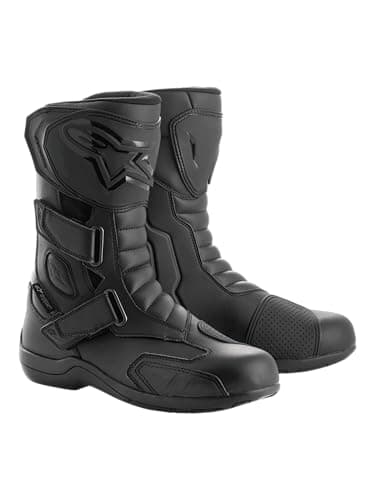
Alpinestars Alpinestars Radon Drystar
Alpinestars Radon Drystar

The certified waterproof default: CE certified to EN 13634:2010 with a Drystar membrane, dual-density ankle protectors and a TPU shin plate — a real protective boot that happens to also keep the rain out.

Best waterproof boot overall
8.5
$259.95Amazon
02
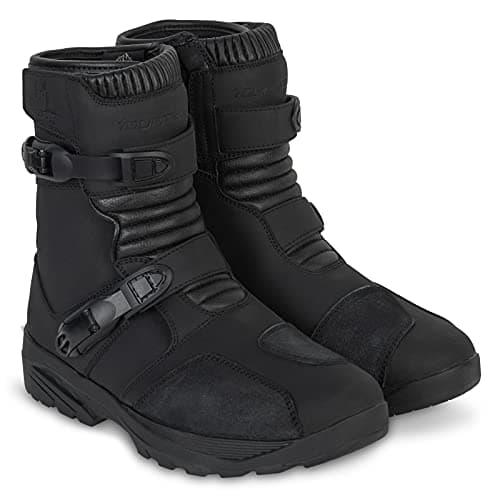
Tourmaster Tourmaster Break Trail WP
Tourmaster Break Trail WP

The value waterproof boot: a HiPora three-layer membrane under an Italian microfiber upper, with dual-density ankle armor and MX-style buckles, for roughly half the price of the premium pairs.

Best value waterproof
8.5
$149.99Amazon
03
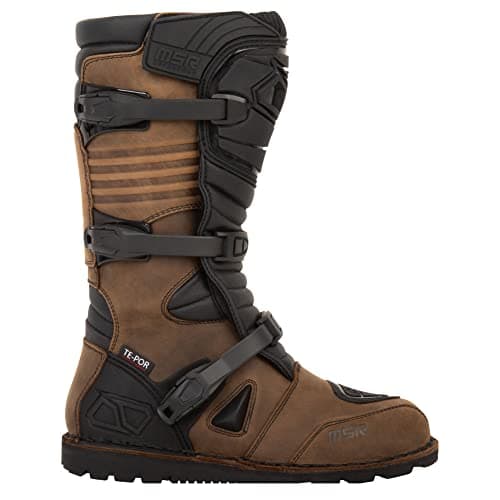
MSR MSR Waterproof Adventure Boot
MSR Waterproof Adventure Boot

Full-grain leather over a Te-Por membrane with a steel shank and injection-molded guards — the boot to buy if your wet rides include gravel, ruts and standing on the pegs.

Best for adventure riding
8.4
$215.99Amazon
04
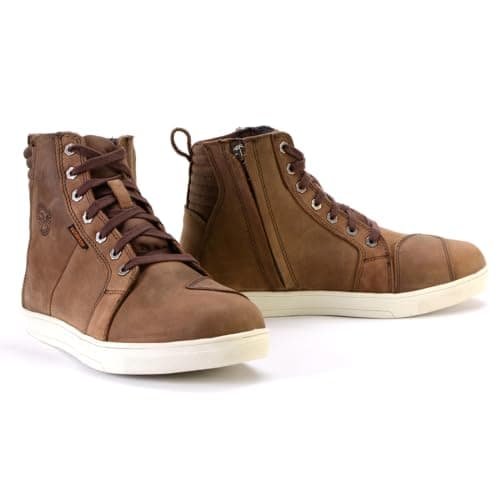
Milwaukee Leather Milwaukee Leather MBM9113
Milwaukee Leather MBM9113

A waterproof leather riding shoe rather than a boot: reinforced with ankle support and cut to pass as ordinary footwear, for riders whose wet commute ends at a desk.

Best waterproof commuter shoe
8.4
$99.99Amazon

#ad · Live prices from the Amazon Product API, as of Sep 4, 2026. Where we have no verified live price we show none — we would rather leave a gap than print a number that has rotted.

In detail

The picks, in full

01
Alpinestars Alpinestars Radon Drystar

Best waterproof boot overall

Alpinestars Radon Drystar

CE EN 13634:2010Drystar membraneDual-density ankleTPU shin plate
8.5/10

The certified waterproof default: CE certified to EN 13634:2010 with a Drystar membrane, dual-density ankle protectors and a TPU shin plate — a real protective boot that happens to also keep the rain out.

Protection
9
Fit/comfort
8.2
Weather
9.6
Walkability
7.4
Value
8.4

Pros

  • Published CE EN 13634:2010 certification — not just a waterproof claim
  • Drystar waterproof and breathable membrane sits between the upper and the lining
  • Dual-density ankle protectors on both sides, plus a TPU shin plate and shift pad
  • Three lateral hook-and-loop straps let you dial the closure around your calf

Cons

  • Microfiber upper does not develop the character of leather
  • Stiffer to walk in than a touring boot with a softer sole

Don't buy this if…

you want a boot that passes for street footwear off the bike — this looks like what it is.

$259.95View on Amazon

Price as of Sep 4, 2026. Prices change — Amazon's is the one that counts.

#ad · we may earn a commission from this link to Alpinestars Radon Drystar

02
Tourmaster Tourmaster Break Trail WP

Best value waterproof

Tourmaster Break Trail WP

HiPora 3-layerDual-density ankleMX-style bucklesAnti-twist midsole
8.5/10

The value waterproof boot: a HiPora three-layer membrane under an Italian microfiber upper, with dual-density ankle armor and MX-style buckles, for roughly half the price of the premium pairs.

Protection
8.2
Fit/comfort
8.4
Weather
8.8
Walkability
8
Value
9.2

Pros

  • HiPora three-layer waterproof and breathable membrane at a mid-budget price
  • Dual-density molded ankle protectors, TechnoGI heel cup and toe cap, reinforced shifter guard
  • Uni-directional anti-twist nylon midsole — the feature that resists an ankle rolling sideways
  • Hook-and-loop top closure fits a wide range of calf sizes

Cons

  • No CE EN 13634 class published
  • Mid-height shaft gives less shin coverage than a tall touring boot

Don't buy this if…

you want maximum shin coverage or a stated CE class — this is the value pick, honestly labeled.

$149.99View on Amazon

Price as of Sep 4, 2026. Prices change — Amazon's is the one that counts.

#ad · we may earn a commission from this link to Tourmaster Break Trail WP

03
MSR MSR Waterproof Adventure Boot

Best for adventure riding

MSR Waterproof Adventure Boot

Te-Por membraneFull-grain leatherSteel shankMolded shin & toe
8.4/10

Full-grain leather over a Te-Por membrane with a steel shank and injection-molded guards — the boot to buy if your wet rides include gravel, ruts and standing on the pegs.

Protection
8.6
Fit/comfort
8
Weather
9.2
Walkability
7.8
Value
8.4

Pros

  • Full-grain leather upper over a waterproof Te-Por membrane — leather ages better than microfiber
  • Steel shank stops the sole folding over a peg when you stand up
  • Injection-molded shin, toe plate and heel plus reinforced medial protection
  • Made in Europe, with an anti-slip rubber sole that works off the bike

Cons

  • No CE EN 13634 class published for this model
  • Heavier than a road touring boot, and the ADV height takes getting used to

Don't buy this if…

you want a published CE certification — the Alpinestars Radon states one and this does not.

$215.99View on Amazon

$226.685% off

Price as of Sep 4, 2026. Prices change — Amazon's is the one that counts.

#ad · we may earn a commission from this link to MSR Waterproof Adventure Boot

04
Milwaukee Leather Milwaukee Leather MBM9113

Best waterproof commuter shoe

Milwaukee Leather MBM9113

Waterproof leatherAnkle supportReinforcedLow profile
8.4/10

A waterproof leather riding shoe rather than a boot: reinforced with ankle support and cut to pass as ordinary footwear, for riders whose wet commute ends at a desk.

Protection
6.8
Fit/comfort
8.6
Weather
8.4
Walkability
9.2
Value
8.8

Pros

  • Waterproof leather at the bottom of the price range
  • Ankle support and reinforcement, unlike the sneakers most commuters actually ride in
  • Looks like normal footwear once you are off the bike

Cons

  • No CE EN 13634 certification published
  • A shoe covers far less of the ankle and shin than a proper boot

Don't buy this if…

you want real shin and ankle armor — a low shoe cannot give you what a tall boot does, at any price.

$99.99View on Amazon

Price as of Sep 4, 2026. Prices change — Amazon's is the one that counts.

#ad · we may earn a commission from this link to Milwaukee Leather MBM9113

What "waterproof" actually means on a boot

There are three levels of claim and they are not equivalent. Water-resistant means treated leather that holds off a shower and then wets through — plenty of boots are sold this way and the word is doing a lot of work. Waterproof membranemeans a separate layer laminated between the upper and the lining that blocks liquid water while letting vapor out: GORE-TEX is the famous one, and the boots here use Alpinestars' Drystar, HiPora and Te-Por. A membrane boot stays dry for hours, not minutes. The third level is waterproof-and-breathable, which is what all three of those membranes claim — and it matters, because a rubber overboot keeps rain out and sweat in, and you end up wet anyway.

CE EN 13634 is the certification to look for

EN 13634 is the CE standard written for motorcycle footwear. It tests abrasion, impact-cut resistance, transverse rigidity — how hard the boot resists being crushed sideways — and whether the boot stays on your foot. Boots are rated in performance levels for each. Only the Alpinestars Radonpublishes a stated EN 13634 certification here; the other three publish protective features but no class, and we have said so in their cons rather than implying a grade nobody awarded. That is not the same as saying they are unprotective — the Tourmaster's dual-density ankle armor and the MSR's injection-molded shin plate are real. It does mean nobody has tested the finished boot to a motorcycle standard.

The ankle is what boots are for

Most motorcycle foot and ankle injuries come from crushing and twisting, not abrasion — the bike lands on the foot, or the foot catches and the ankle rotates past where it goes. The features that stop that are dual-density ankle protectors on both the inside and outside of the joint, a rigid heel cup and toe cap, and a torsion-resistant midsole. Tourmaster names theirs a uni-directional anti-twist nylon midsole; MSR uses a steel shank; Alpinestars uses a high-modulus midsole with a structured shank. Whatever the name, the job is the same: stop the sole folding and the ankle rolling. A boot with a soft, flexible sole has none of that, whatever the upper is made of.

Height: how much shin do you want covered?

A tall boot covers the shin and calf and gives the most protection and the best seal against water running down your leg — the touring and adventure choice. A mid-height boot like the Break Trail trades some shin coverage for easier walking and a lower profile under jeans. A riding shoe like the Milwaukee stops at the ankle: far better than a sneaker, far less than a boot. In the wet the height question is also a drainage question — water running off your pants will find the top of a low boot, which is why touring riders wear their pant leg over the boot rather than tucked in. Our short vs tall boots comparison covers the trade in detail.

Breathability, or why waterproof boots can still leave you damp

A membrane that blocks liquid water still has to pass water vapor, or your own sweat condenses inside the boot and you arrive wet from a dry ride. This is the single most common complaint about cheap "waterproof" boots, and it is why the named membranes here all advertise breathability rather than just waterproofing. It is also why a waterproof boot is a poor summer boot: in genuine heat you want mesh and vents, not a membrane. If you ride year-round, the honest answer is usually two pairs, and our main boots ranking covers the dry-weather half.

Sole and walkability

A waterproof boot spends a lot of its life on wet ground — fuel-station forecourts, muddy verges, car parks in the rain — so the sole compound and tread matter more than they do on a summer boot. Look for an oil- and slip-resistant lugged sole, and remember that the stiffer the boot is for protection, the worse it walks. The Radon is the stiffest here, the Milwaukee shoe the easiest to spend a day in. Decide honestly how much walking your riding involves before you buy the most protective option and then leave it in the garage.

Which one should you buy?

Buy the Alpinestars Radon Drystar if you want published CE certification and real waterproofing in one boot. Buy the Tourmaster Break Trail WP if you want most of that protection and a proper membrane for meaningfully less money. Buy the MSR Adventure boot if your wet riding leaves pavement. Buy the Milwaukee MBM9113 if the real alternative is commuting in soaked sneakers. Then check the sizing advice in our boot buying guide — waterproof boots are usually cut for a thicker sock, and buying your street size is how riders end up with cold, cramped feet.

How we picked

We don't test helmets. Here's what we do instead.

Everyone in this category says they tested twenty helmets. We haven't tested any — and we say so. What we do instead: compile the published DOT, ECE 22.06 and Snell certifications, the manufacturer's fit, weight and shell specs, the CE armor levels, and reputable published reviews, then score each pick against a published rubric. The scores are judgments from documented research — not measurements we took, because we do not run a lab and we are not going to pretend we do. Every certification and spec claim traces to a source we name and link.

Questions

Frequently asked

Are waterproof motorcycle boots breathable?
The good ones are. Drystar, HiPora and Te-Por are all waterproof-and-breathable membranes, which means they block liquid water while passing water vapor out. A boot that is waterproof but not breathable traps sweat, and you end up damp from the inside — the most common complaint about cheap waterproof boots.
Do waterproof boots stay waterproof forever?
No. Membranes degrade with abrasion, folding and dirt, and the outer material's water-repellent treatment wears off first, which makes the boot "wet out" and feel like it is leaking even when the membrane is intact. Clean them, re-treat leather and expect a hard-worn boot to lose some performance after a few seasons.
What is CE EN 13634 on a motorcycle boot?
It is the CE standard for motorcycle footwear. It tests abrasion resistance, impact-cut resistance, transverse (crush) rigidity and whether the boot stays on your foot, and rates the boot in performance levels. A boot with a printed EN 13634 mark has been tested to a motorcycle standard; one without may still be well built, but nobody has certified it.
Can I just wear waterproof hiking boots?
They will keep you dry and do almost nothing else. Hiking boots have no ankle armor, no rigid heel cup or toe cap, no torsion-resistant midsole and no shift pad, and their soft soles are exactly what lets an ankle roll. Waterproofing is the easy half of a motorcycle boot's job.
Should I size up for waterproof boots?
Often, slightly. Membrane boots are usually built with room for a thicker sock, and a boot that is snug in summer socks will feel tight and cold in winter ones — a compressed foot loses circulation and gets colder, not warmer. Check the maker's chart and try them with the socks you actually ride in.

Keep reading

Receipts

Sources

We do not run a testing lab, and we do not pretend to. Our picks are built from published certifications, manufacturer spec sheets, the standards documents themselves, and reputable published reviews — named and linked above. Where we could not verify something, we say so on the page rather than quietly leaving it out. Read our full method.