The honest answer first: wear them, in short bursts, indoors, before you commit to a long ride— and know that break-in only solves one kind of problem. A motorcycle boot's upper softens and conforms across the width, at the flex point over the ball of the foot and around the ankle collar. It does not get longer, it does not reshape the last, and it does not lower a high instep. If the boot is tight across the forefoot it will probably come good in a couple of weeks. If it is short, or the ankle armor is sitting in the wrong place, no amount of wearing will fix it and the right move is a return.
That distinction is the entire point of this page, because the internet's advice for breaking in motorcycle boots is mostly advice for breaking in cowboy boots: soak them, freeze a bag of water inside them, heat them with a hairdryer. A riding boot is not one piece of leather. It is a laminated structure — upper, waterproof membrane where fitted, lining, molded ankle protectors, a heel counter, a toe cap and an anti-twist midsole — and several of those components are glued. Soaking a membrane boot can delaminate it. Heating a TPU protector can distort it. The protection is the part you cannot see, and the aggressive methods attack exactly that.
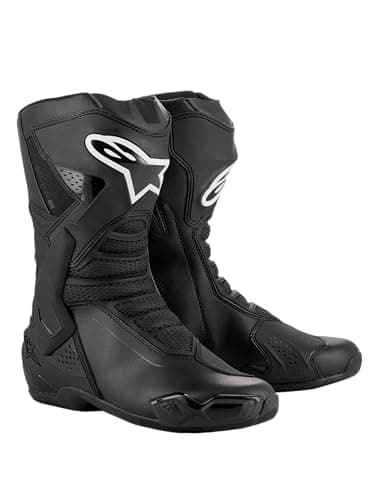
How long should it take? For a leather or microfiber riding boot, plan on two to four weeks of normal use before the boot stops announcing itself, and for a stiff sport-touring boot a little longer. Alpinestars publishes the trade-off plainly on the SMX-6 V3 we rank first on this site: it is stiffer than a casual boot until broken in. That is a known characteristic of a protective sole, not a defect.
What to look for before you start breaking anything in
Run these four checks on day one, in the house, with the receipt intact. Three of them are return-it-now answers.
- Length. Stand up. Your longest toe should not touch the end when your weight is on the foot. A boot stretches across the width and almost nothing in length, so short is short forever.
- Ankle armor position. The molded protector should sit over your ankle bone, not above or below it. This is set by the last and the shaft height, and wearing the boot does not move it. A pad in the wrong place is a pad doing nothing.
- Instep height. If the boot will not close over the top of your foot, or the closure digs into the arch, that is instep volume and it is structural. Width gives; instep does not.
- Closure range over your riding trousers. Fasten the boot over the jeans or riding pants you actually wear. If it only just closes at the last buckle hole or the end of the hook-and-loop, treat it as too small — you will want that room over a winter sock.
If all four pass and the boot is simply snug and stiff, you have a break-in job rather than a sizing mistake. Our boot fit guide runs the same checks in more depth, including the on-the-bike tests, and it is the page to read before you buy rather than after.
The short answer
| # | Product | Best for | Score | Price |
|---|
| 01 | Alpinestars SMX-6 V3The do-most sport-touring boot: CE-certified, tall enough to guard the shin, stiff enough to resist a twist, and comfortable enough to walk in — the boot most street riders should buy. | Best overall boot | | $349.95·Amazon |
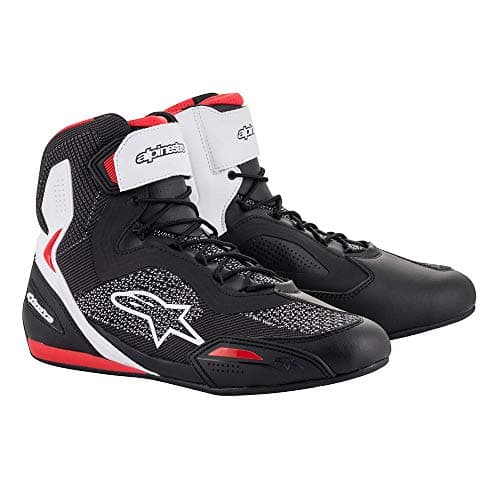
| 02 | Alpinestars Faster-3 RideknitThe hot-weather answer: knitted mesh panels and a 3D mesh lining over a certified chassis with a TPU ankle and a support shank. This is the shoe for riders whose alternative, on a 95-degree commute, is riding in actual sneakers. | Best for hot weather | | $199.00·Amazon |
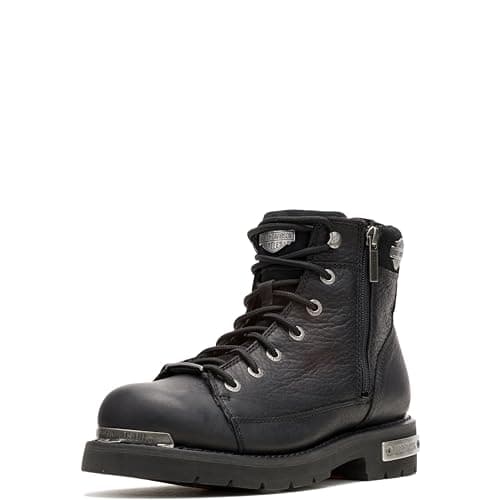
| 03 | Harley-Davidson ChipmanA short leather boot that looks the part on a cruiser and is comfortable off the bike — honest about being style-first, with less armor than a sport boot but real leather and a grippy sole. | Best cruiser / casual look | | $119.97·Amazon |
#ad · Live prices from the Amazon Product API, as of October 19, 2026. Where we have no verified live price we show none — we would rather leave a gap than print a number that has rotted.
In detail
Best overall boot
EN 13634 CETall shaftAnkle armorTorsion-controlled sole
The do-most sport-touring boot: CE-certified, tall enough to guard the shin, stiff enough to resist a twist, and comfortable enough to walk in — the boot most street riders should buy.
- Protection
- 9
- Fit/comfort
- 8.4
- Weather
- 8.4
- Walkability
- 7.6
- Value
- 8.2
Pros
- +CE-certified with ankle protection and a controlled-flex sole
- +Tall shaft guards the shin and ankle without feeling like a race boot
- +Reasonably walkable off the bike
Cons
- −Pricey
- −Stiffer than a casual boot until broken in
Don't buy this if…
…you want a low, casual boot you can wear all day off the bike — this leans sport.
Best for hot weather
CE EN13634:2017Knitted mesh upperTPU + dual-density ankleIntegrated support shank
The hot-weather answer: knitted mesh panels and a 3D mesh lining over a certified chassis with a TPU ankle and a support shank. This is the shoe for riders whose alternative, on a 95-degree commute, is riding in actual sneakers.
- Certification
- 8.2
- Protection
- 8.2
- Weather
- 5.6
- Walkability
- 9.2
- Value
- 8.2
Pros
- +Knitted mesh panels and a 3D mesh lining make it the airiest shoe here by a wide margin
- +Enhanced TPU ankle extended into the lower lateral area plus medial dual-density ankle protectors, over a rubber sole with an integrated support shank
- +Alpinestars states the certification precisely on its own product page — "CE EN13634:2017" with an issue date — rather than leaving it to the retailer
Cons
- −No membrane and no water resistance: knit panels wet through in the first shower and stay wet
- −Alpinestars publishes the standard but not the level reached in each rated area, so you cannot compare it directly against the REV'IT or the SHIMA
- −The lowest-cut shoe in this group, so ankle coverage is the least here, and the lateral strap-over-laces closure is fussier than a quick lace
Don't buy this if…
…you want one pair of shoes for the whole year — this is a warm, dry-weather shoe, and the Dartwood or the Chrome Drystar covers far more of the calendar.
Best cruiser / casual look
Full-grain leatherShort shaftOil-resistant soleCasual style
A short leather boot that looks the part on a cruiser and is comfortable off the bike — honest about being style-first, with less armor than a sport boot but real leather and a grippy sole.
- Protection
- 6.8
- Fit/comfort
- 8.8
- Weather
- 7.2
- Walkability
- 9.2
- Value
- 8
Pros
- +Classic cruiser look in full-grain leather
- +Comfortable and walkable all day
- +Oil- and slip-resistant sole
Cons
- −Short shaft and limited armor — style-first, not a race boot
- −No CE motorcycle certification stated
Don't buy this if…
…you want maximum ankle armor and shin coverage — a taller CE sport boot protects more.
The method that works
Nothing clever. Short sessions, increasing, with the boot fastened the way you will actually ride it.
- Wear them around the house, an hour at a time, in riding socks. Fasten every buckle and strap to the setting you will ride at. Indoors means you can stop, and it means the boot comes back clean if you decide to return it.
- Flex the sole deliberately. Stand and rock forward onto the balls of your feet, repeatedly. The flex point over the ball of the foot is where a protective sole feels worst and softens most; walking on carpet barely loads it.
- Work the ankle through its range. Sit down and rotate each ankle, then do a few squats. This is the motion that settles the ankle collar and the armor pocket, and it is the motion a shift lever and a rear brake pedal demand.
- Then ride short. A commute or an hour, not a four-hundred-mile day. Pay attention to the gear lever against the top of your left boot and to the brake pedal feel, because a stiff new sole genuinely changes both.
- Re-set the closure as it relaxes. A boot with lateral hook-and-loop straps — the Alpinestars Radon Drystar publishes three of them — can be tightened a notch as the upper gives. A fixed zip has no such adjustment, which is why adjustable closures are worth paying for.
What helps, and what to leave alone
| Method | Verdict | Why |
|---|
| Short wear sessions, increasing | Do it | The only method that works on every construction, with no risk |
| Thicker or thinner socks | Do it | A genuinely free half-size of adjustment in both directions |
| Leather conditioner on full-grain leather | Carefully | Softens and feeds the hide; use sparingly and never on microfiber or suede |
| A shoe stretcher, in the forefoot only | Last resort | Can relieve width; cannot add length and will not lower an instep |
| Soaking the boot or wearing it wet | Do not | Risks delaminating a waterproof membrane and the glued layers around it |
| Heat gun or hairdryer on the shell | Do not | Molded TPU protectors and heel counters can distort, and that is the protection |
| Freezing a water bag inside | Do not | Same delamination and distortion risk, with no control over where it stretches |
| Riding a long day on day one | Do not | How a hot spot becomes a blister and a returnable boot becomes a worn one |
Different uppers, different break-in
Full-grain leatheris the material break-in advice was written for. It genuinely moulds to the foot, it takes conditioner, and it keeps improving for months — the Harley-Davidson Chipman is a short full-grain leather boot and the clearest example here. It is also the slowest to come good.
Microfiber, which is what most modern sport and touring boots use, softens at the flex points and then stops. It will never develop the character of leather — Alpinestars says as much in its own description of the Radon Drystar — and conditioner does nothing for it. Give it two weeks and judge it then.
Knit and mesh uppers essentially skip the process. The Alpinestars Faster-3 Rideknit is a knitted mesh shoe over a certified chassis and it feels like a trainer from the first wear, which is exactly why it is on this page: if you want zero break-in, that construction is how you get it, and the cost is that knit panels wet through in the first shower and stay wet. Our riding shoes ranking covers that whole category, and waterproof boots covers the opposite priority.
Four problems break-in will never solve
- Length. It does not get longer. Send it back.
- The shape of the last. Heel width, forefoot shape and the overall form the boot was built around are fixed. European sport boots in particular run narrow, and a foot that is comfortable in a US work boot may simply not fit that last in any size.
- A high instep. The arch of your foot against the closure is a volume problem, not a width problem. The boot does not get deeper.
- Calf circumference on a tall boot. A fixed shaft has no adjustment range at all. If it will not close over a riding sock now, it will not in February — look for a boot with a published calf adjustment, like the wide-entry aperture on the Alpinestars Toucan in our adventure boot ranking.
While you are breaking them in
Two small things save a lot of annoyance. Keep the boots unfastened and upright between rides rather than folded over, so the shaft keeps its shape and the inside dries. And if they came damp from a wet commute, dry them at room temperature, away from a radiator — heat is as bad for a glued boot during drying as it is during break-in. For the field as a whole, our motorcycle boots ranking, beginner boots page and how to choose boots guide cover what to buy; this page is about living with what you bought.
How we picked
Everyone in this category says they tested twenty helmets. We haven't tested any — and we say so. What we do instead: compile the published DOT, ECE 22.06 and Snell certifications, the manufacturer's fit, weight and shell specs, the CE armor levels, and reputable published reviews, then score each pick against a published rubric. The scores are judgments from documented research — not measurements we took, because we do not run a lab and we are not going to pretend we do. Every certification and spec claim traces to a source we name and link.
Questions
How long does it take to break in motorcycle boots?+
Two to four weeks of normal use for a leather or microfiber riding boot, and a little longer for a stiff sport-touring sole. Knit and mesh uppers need essentially no break-in at all. If a boot still has a specific hot spot after a month of wear, it is a fit problem rather than a break-in problem.
Can I stretch motorcycle boots that are too tight?+
Across the width, a little — with wear, thinner socks, or a shoe stretcher used gently in the forefoot. In length, no. And nothing will lower a high instep or change the shape of the last. Those three are structural and are a return, not a project.
Should I wet motorcycle boots to break them in?+
No. Wet-moulding is advice carried over from single-layer leather footwear. A riding boot is a laminated structure with glued layers and often a waterproof membrane, and soaking it risks delamination. The same applies to heat guns and hairdryers, which can distort the molded TPU protectors that are doing the protecting.
My new boots hurt the top of my foot. Is that break-in?+
Usually not. Pressure across the top of the foot is instep volume, which does not change with wear. Try loosening the lower closure or a thinner sock first; if that does not fix it, return them. Pain over the ankle bone is also structural — it means the molded protector is not sitting where your ankle is.
Do waterproof boots break in differently?+
Yes, less. A membrane boot has a lining layer bonded in behind the upper, so the upper cannot conform as freely and the boot tends to soften at the flex points and then stop. It also rules out every wet break-in method. See our
waterproof boots ranking for how those boots are built.
Will leather conditioner help break boots in?+
On full-grain leather, used sparingly, yes — it feeds the hide and speeds up the softening. On microfiber, suede or knit it does nothing useful and can clog a perforated upper. Check what your boot's upper actually is before you put anything on it.
Receipts
We do not run a testing lab, and we do not pretend to. Our picks are built from published certifications, manufacturer spec sheets, the standards documents themselves, and reputable published reviews — named and linked above. Where we could not verify something, we say so on the page rather than quietly leaving it out. Read our full method.