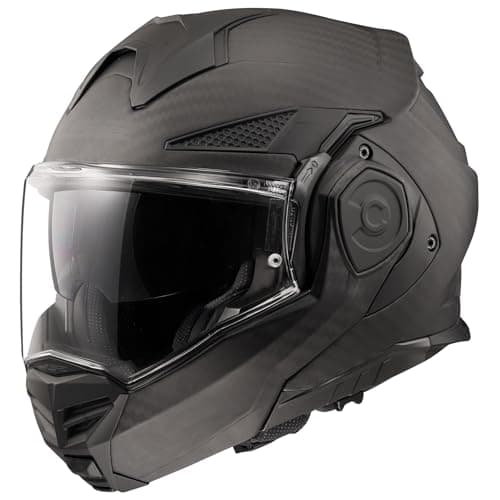
If you want one helmet with a built-in sun visor and you want the maker to have put the most on paper about it, buy the LS2 Advant X Carbon: it is the only helmet here that publishes DOT FMVSS 218 and ECE 22.06, it is P/J dual-homologated so it is certified with the chin bar up as well as down, and it ships with both the internal sun shield and a Pinlock 120 anti-fog lens in the box. If that is more helmet than you need, the Scorpion EXO-R430 is the mid-price full-face answer and the HJC i90 is the cheap one. All five helmets on this page are certified, and all five publish what their sunshield is.
A drop-down sun visor — makers also call it an internal sunshield, a sun shade or a SpeedView visor — is a tinted second lens that lives inside the shell, above the eye port, and slides down on a lever when the sun gets low. It is the single most useful feature on a commuting helmet, because the alternative is riding into a west-facing sunset with a clear shield and squinting, or carrying a second tinted shield and swapping it in a parking lot, or wearing sunglasses under a helmet that was not designed around them.
The feature is also where a lot of vague marketing lives, so this page ranks on three documented things and nothing else:
- What certification does the maker publish, and how specific is it? A sunshield is a convenience; the shell is the reason you are wearing the helmet. "DOT FMVSS 218 and ECE 22.06" is a better answer than "DOT approved," and our DOT vs ECE vs Snell guide explains why.
- What is the sunshield, in the maker's own words? How many positions it has, whether it is UV-rated, whether it is anti-scratch coated, and whether an anti-fog insert comes with it.
- Which shell type is it in? A sun visor is not a shell type. It shows up in full-face, modular, convertible and open-face helmets, and the shell you need is decided by your riding, not by the visor. That is why this page deliberately spans four form factors instead of ranking five modulars.
We have not worn these helmets, measured a tint percentage or run a lab. Every specification below is quoted from the maker's or retailer's published spec sheet, every source is linked at the bottom, and where a maker publishes nothing we say so rather than guessing. If you are shopping by shell type rather than by feature, our full-face ranking, modular ranking and open-face ranking are the better lists, and every one of them notes which picks carry a sunshield.
The sunshield spec sheet, side by side
These are the published figures, in the makers' and retailers' own terms. Where a cell says "not published," that is the honest state of the spec sheet, not an omission on our part.
| Helmet | Shell type | Published certification | Sunshield, as published | Anti-fog in the box |
|---|
| LS2 Advant X Carbon | Modular (P/J) | DOT FMVSS 218 + ECE 22R06 | Internal sun shield | Pinlock 120 lens included |
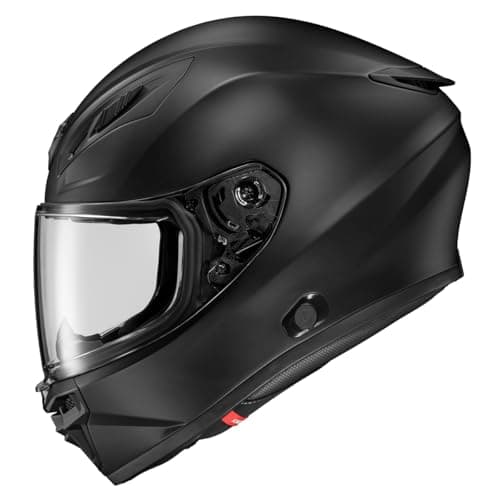
| Scorpion EXO-R430 | Full-face | DOT + ECE | Drop-down sun visor | Pinlock-ready, insert not included |
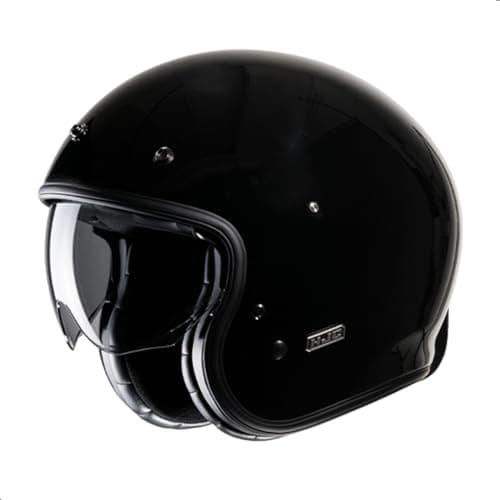
| HJC V31 | Open-face (3/4) | DOT FMVSS 218 | IS-10, three-step adjustable, anti-scratch, blocks 99% UV | Not published |
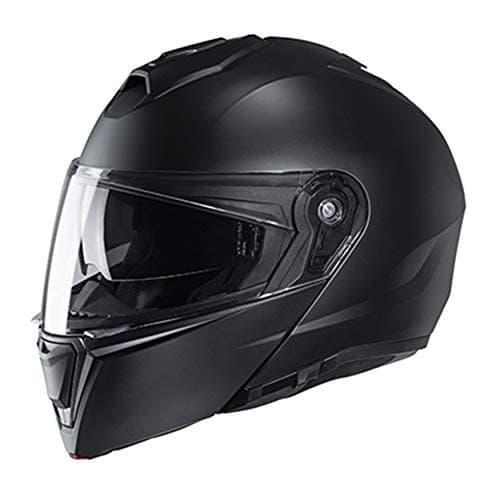
| HJC i90 | Modular | DOT + ECE | Internal sun visor | Pinlock-ready, insert not included |
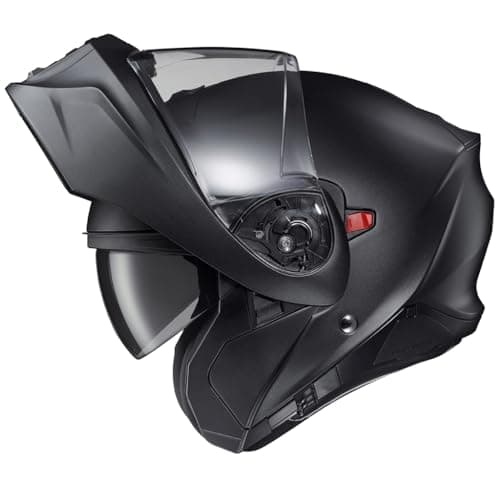
| Scorpion EXO-GT930 | 3-in-1 convertible | DOT | Drop-down sun visor | Pinlock-ready, insert not included |
Why the sunshield does not change the certification
The most common worry about these helmets is that cutting a channel into the shell for the sunshield must weaken it. It does not work that way, and the reason is in how the helmet is built. The sunshield sits insidethe outer shell, in a recess moulded into the EPS liner above the eye port, and the helmet is submitted for certification as a complete product with the mechanism fitted. A DOT or ECE label on a sunshield helmet is a label awarded to that helmet including its sunshield; there is no separate "without the visor" version that was tested instead.
What the mechanism genuinely costs you is space and grams. The recess has to go somewhere, which on most designs means slightly thicker EPS above the brow or a slightly deeper shell, and the mechanism itself adds weight. Our open-face pick says so in its own cons: if you want the lightest classic 3/4 shell, the sunshield mechanism adds weight a bare shell does not carry. On a modular the penalty is smaller in relative terms because the flip-up hinge already costs more than the shield ever will — our modular vs full-face comparison puts numbers on that trade.
Sunshield, tinted shield, or sunglasses?
A sunshield is the convenient option and the only one that works when the light changes mid-ride: into a tunnel, under tree cover, or when the sun drops behind a ridge. You flick it up with a lever on the left of the shell and you are back to a clear view in under a second, with no stopping, no second visor in a backpack and nothing to scratch on a kerb.
A tinted outer shield is optically better and darker. It is a single lens in your line of sight rather than two, and dedicated tinted shields come in heavier tints than almost any internal sunshield. The catch is that it is a committed decision: it is dangerous after dark and you have to carry and swap the clear one. Track and canyon riders accept the swap; commuters generally do not.
Sunglassesare the worst of the three inside a helmet and the most common anyway. The arms run exactly where the cheek pads clamp, which is why riders in glasses need a helmet with eyewear channels — our helmets for glasses ranking is built around that single requirement, and it is a different list from this one. If you already wear prescription glasses, you want a helmet with channels and a sunshield, and the overlap between the two pages is where to start.
The sunshield does nothing about fog, and fog is the real problem
An internal sunshield adds a second surface inside your helmet for warm, wet breath to condense on, and it is closer to your face than the outer shield is. It does not cause fogging, but it gives fogging somewhere extra to happen, and a fogged sunshield is harder to clear than a fogged outer shield because you cannot crack it open at a light. The fix is the same as it always is: a sealed Pinlock-style anti-fog insert on the outer shield, which keeps the warm air off the cold lens in the first place. Only the LS2 here puts that insert in the box; the Scorpions and the HJC i90 are Pinlock-ready and sell it separately. Our guide to stopping visor fog covers the rest, including why a breath guard matters more than any coating.
Which one should you buy?
Buy the LS2 Advant X Carbonif you want the most documented helmet on the page: both standards published by number, P/J dual homologation so it is certified with the chin bar raised, a 9K carbon shell at a published 1,470 ±50 g, and the anti-fog lens included. Buy the Scorpion EXO-R430 if you want a straightforward full-face with a sunshield and no flip-up hinge to pay for or carry. Buy the HJC V31if you ride a cruiser in a 3/4 and want the best-documented sunshield here — three positions, anti-scratch, 99% UV — accepting that a 3/4 leaves your jaw unprotected. Buy the HJC i90 if you want a certified modular with a sun visor for the least money, and the Scorpion EXO-GT930 if one shell needs to be a full-face, a modular and an open-face on different days.