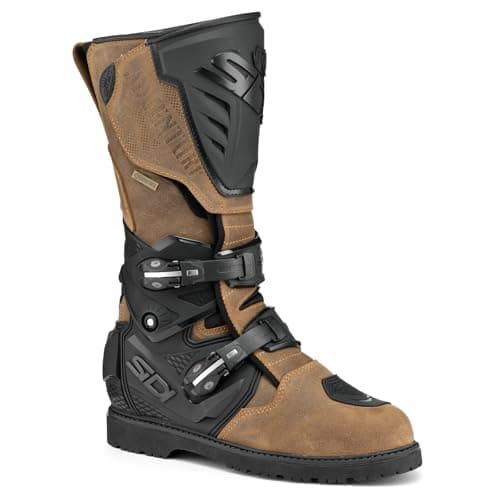
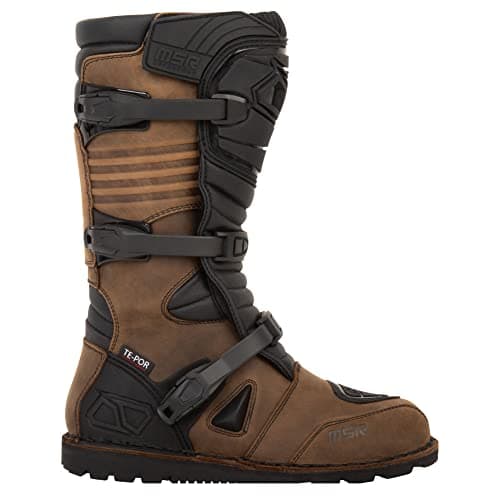
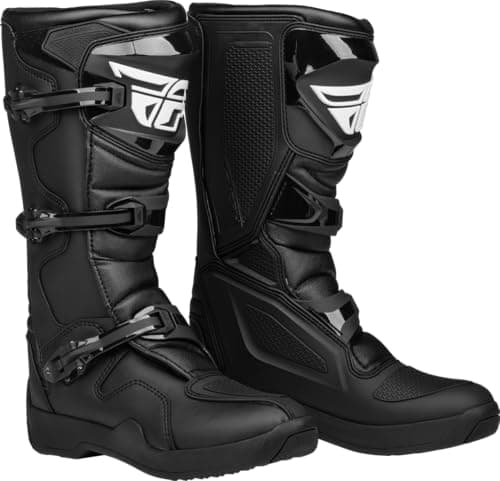
For most trail and enduro riders the boot to buy is the FLY Racing Maverik LT: a CE-certified off-road boot with a pre-shaped shin guard, an articulated ankle hinge that resists hyperextension, three aluminum quick-lock buckles and a replaceable toe slider, at roughly a quarter the price of a premium adventure boot. It is for the rider who actually rides dirt — fire roads, singletrack, rocks, pegs — and wants the hardware that handles it without paying for a Gore-Tex touring boot. If you want the highest published certification instead, the Sidi Adventure 2 Gore-Tex is the only boot on this page that publishes CE Level 2 across rigidity, impact, abrasion and cut.
One thing has to be said before the ranking, because it decides whether this page is for you at all. None of these is a motocross race boot.A gate-drop MX boot — the hinged, plated, four-buckle kind built for jump landings and a bike coming down on your leg — is a different product at a different price, and we do not rank one here because our catalog does not carry one we can verify. What is below are trail, enduro and dual-sport boots: tall or mid shafts with real shin coverage, soles stiff enough not to fold over a peg, and buckles you can work with gloves on. For most people riding dirt on weekends that is the correct boot. If you race motocross, buy a race boot and treat this page as the floor rather than the answer.
What actually matters in a dirt boot
- A shin plate, not shin padding. Off-road the injuries come from the bike and the ground hitting the front of your leg: a peg, a rock, a rut, the bike coming back at you. A pre-shaped plastic shin guard spreads that load; foam does not. FLY publishes a pre-shaped shin guard on the Maverik LT and O'Neal publishes a shin plate on the Rider.
- A sole stiff enough to stand on. Dirt riding is done standing on the pegs, and a soft sole folds around the peg and puts the load into your arch. A steel shank is the published spec to look for: FLY states one on the Maverik LT, MSR states one in the Adventure boot.
- Something that limits the ankle, in both directions. The classic off-road ankle injury is hyperextension, or a sideways roll with the bike on top. An articulated hinge (FLY) or a named anti-torsion system (Sidi) is engineering aimed at exactly that. A tall, stiff shaft (O'Neal) is the low-budget version of the same idea.
- Buckles you can operate in gloves, and replace. Aluminum quick-lock buckles with memory straps are a maintenance item on a dirt boot, not a luxury — they get hit. The same goes for a replaceable toe slider, which is the part that grinds away first on a boot that gets dabbed in corners.
- Debris sealing, which is not waterproofing. An elastic gaiter keeps grit, mud and spray out of the top of the boot. That is not the same as a membrane: the Maverik LT publishes no waterproof membrane at all, while MSR publishes a Te-Por membrane and Sidi a full-length Gore-Tex gaiter. Work out which problem you have before paying for the other one.
If your riding is more dirt than distance, the ranking changes: our dirt bike boots page ranks the same field on shin coverage, hinge control and sole stiffness instead of membranes and walkability, and the order comes out differently.
Break-in and care are the same project seen at different points in a boot's life. Once the boot is yours, our boot care guidecovers cleaning, drying and conditioning by material — including the heat-drying mistake that undoes everything you achieved here.
A membrane boot only stays waterproof if it is looked after: our boot care guidecovers washing the outer, re-treating it and drying it without cooking the membrane, which is the usual reason a "failed" boot starts leaking.
We have not ridden, crashed or crushed any of these boots. Every certification, membrane and hardware claim below is the maker's own published specification, linked at the bottom of the page and scored against our published rubric.
The four, on what their makers publish
| Boot | Published certification | Shin / shaft | Wet weather | Who it is for |
|---|
| FLY Racing Maverik LT | CE certified, no level breakdown published | Pre-shaped shin guard, articulated hinge, steel shank | Gaiter only — no membrane published | The default trail and enduro boot |
| Sidi Adventure 2 Gore-Tex | EN 13634:2017, Level 2 on rigidity, impact, abrasion and cut | Tall shaft, named anti-torsion system | Full-length Gore-Tex gaiter | If the paperwork has to lead |
| O'Neal Rider Boot | None published | Tall MX shaft with a shin plate, buckle closure | No membrane published | The cheapest tall off-road boot |
| MSR Waterproof Adventure | None published | Molded shin and toe plate, steel shank | Te-Por membrane under full-grain leather | Wet dual-sport and gravel |
Why the certified boot is not first
On a safety-critical page the published standard normally wins, and here it does not, so that needs explaining. The Sidi Adventure 2publishes the strongest spec sheet in our entire boot catalog — Level 2 under EN 13634:2017 across all four rated properties, plus an anti-torsion mechanism. Nothing below it comes close on paper. It is also several times the price of the Maverik LT, built tall and heavy around Gore-Tex, and aimed at loaded adventure touring that happens to include dirt.
The Maverik LT leads because it is the boot built for the riding this page is about, at a price that means you buy it and ride in it: certified, hinged, shin-plated, with a steel shank and a toe slider you can replace when it wears through. If your dirt is the back half of a long road trip, buy the Sidi and read our adventure boots ranking, where it finishes first on exactly these specs.
What a dirt boot does not need
- Walkability. A boot stiff enough to protect your shin and hold your ankle is a boot you waddle in. That is the trade, and a dirt boot is the wrong place to buy it back. If you want something for the trail you can also walk a town in, the Forma Adventure Low on our adventure pageexists for that — and Forma itself states it is not recommended for aggressive off-road use.
- A waterproof membrane, necessarily. Off-road boots get submerged, not rained on. A membrane boot that fills with creek water stays wet all day; a drainable boot dries. Buy the membrane for cold, wet dual-sport miles on pavement, not for summer trail riding.
- Street looks. Every boot here looks like what it is. Our riding shoes ranking is the page for footwear that passes as normal.
Sizing a tall off-road boot
Two measurements decide this, and neither is your shoe size. Calf circumference comes first: a tall buckle boot has a fixed shaft range, and the last buckle either closes over your calf with room for a riding pant and a knee brace, or it does not. Instep heightcomes second — it is what makes a correctly sized boot impossible to get your foot into. Both are covered in detail in our boot fit guide.
Buy by the EU number from the maker's own chart, try them over the socks you ride in, and expect a real break-in on anything with a leather upper — our break-in guide covers what softens with wear and what never will, and our boot care guide covers keeping one alive once the mud starts. If you are assembling a whole off-road kit, the dirt bike helmet ranking and the goggles ranking are the other two purchases that matter most.