Start with the fact that decides how you should read every claim in this category: there is no harmonized EN standard for a motorcycle neck brace. A back protector has EN 1621-2, with a striker, an impact energy and published kN limits. A glove has EN 13594. A jacket has EN 17092. A neck brace has none of that. Braces are CE-marked as personal protective equipment under Regulation (EU) 2016/425, but there is no neck-specific harmonized standard for a notified body to test them against, which means "CE certified" on a neck brace does not carry the same information as the same two words on the pad in your jacket.
That is not a reason to skip a brace. It is the reason this page ranks on documents and mechanism rather than on a level, because a level does not exist to rank on. We looked at four things each maker either publishes or does not: the certificate itself (is there a downloadable CE certificate and Declaration of Conformity, and is the regulation named), the published weight, the adjustment axes (how many directions the fit can actually be tuned in), and the load path— whether the thing has a front and rear striking platform for the helmet rim at all. We do not crash-test braces and we have not worn these; every number below is the maker's own published figure, cited at the bottom of the page.
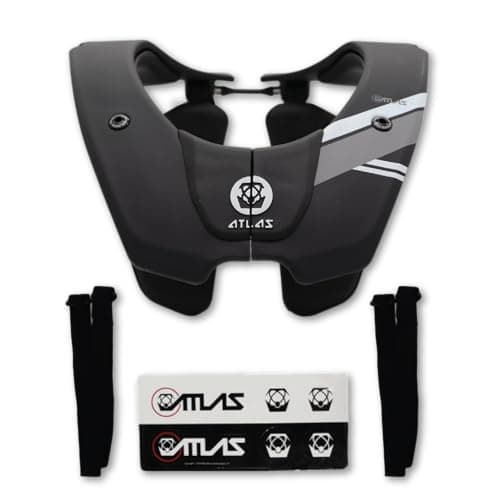
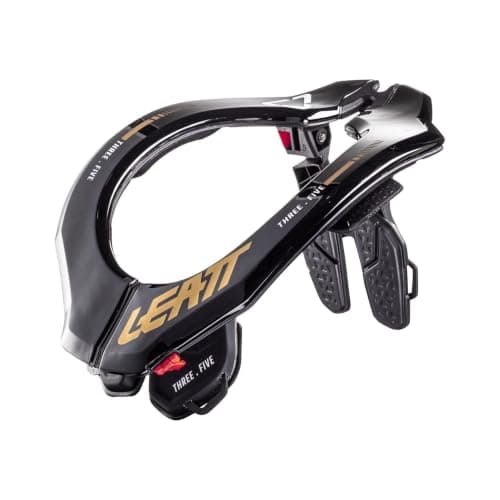
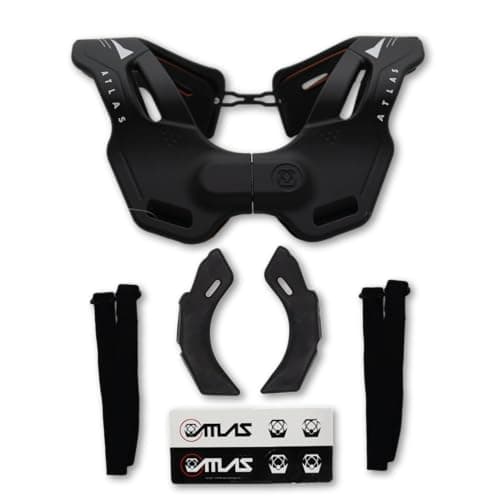
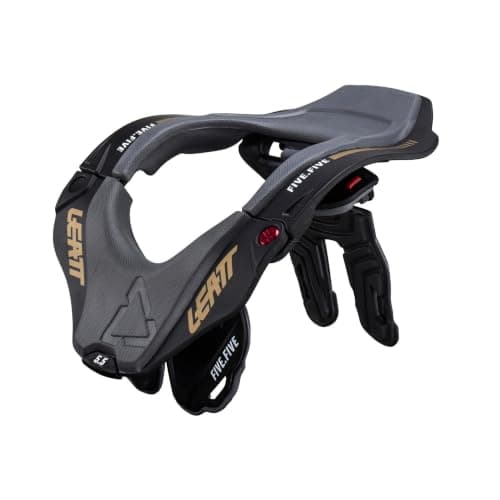
The Leatt Neck Brace 5.5wins because it publishes the most and adjusts in the most directions — it names the regulation by number and puts both the CE certificate and the Declaration of Conformity on its own product page as downloads. The Atlas Air Lite is the off-road pick: lighter, with 30 mm of chest suspension specifically so you can tuck and roll. The Leatt 3.5 is the honest first brace, with the same paperwork as the 5.5 and far less adjustment. And the Atlas Visionis ranked last on purpose, because Atlas itself describes it as an anti-compression collar "designed to reduce compression forces only".
Brand disclosure, up front:two of these four are Leatt and two are Atlas. That is not a shortlist we cut to two brands for convenience — it is what the publishing standard in this category leaves. Leatt and Atlas are the two makers putting weights, adjustment mechanisms and certificate documents on their own pages. Where a third brand sells a brace without publishing any of that, there is nothing for a page built on published specs to rank it on.
A brace is off-road armor first. If you ride on the road, the higher-value upgrade is almost always the empty pocket in your jacket — see our back protectors ranking and, for the decision between a pad and an inflatable, airbag vest vs back protector.
What a neck brace actually does
The mechanism is not "it holds your neck still". A full-platform brace gives the rim of your helmet something to hit other than your spine. In a crash where your head is driven down, back or sideways, the helmet rim lands on the brace's platform, and the brace transfers that load through its frame onto your chest, shoulders and upper back — large, strong structures that can take it. The design intent is to limit how far the head travels and to redirect energy away from the cervical spine.
Two consequences follow, and they explain the whole ranking. First, a brace needs a platform in the directions it is meant to work in; remove the front and rear shelves and you have removed the load path, whatever else the product does. Second, the brace has to be the right distance from your helmet rim— too far and the head travels before anything engages, too close and the rim is already resting on the platform while you ride. That distance is what the adjusters set, which is why adjustment range is a protection spec on this page and not a comfort feature.
Brace or collar? They are different products
This is the single most expensive mistake in the category, because both get sold under the search term "neck brace". A full-platform brace (the three Leatt and Atlas full-frame picks above) has front and rear shelves and a frame that reaches your sternum and spine. An anti-compression collar— which is what Atlas calls the Vision in its own copy — deliberately deletes those shelves to buy back range of motion, and addresses compression only. Then there is a third thing entirely: the foam race collaror "neck roll", a padded doughnut sold for a fraction of the price of any of these. A foam collar stops the helmet rim chafing your neck and does not have a frame, a platform or a load path. It is comfort equipment. None of that is dishonest of the makers; it becomes dishonest when a page lets you believe the three are interchangeable.
Sizing: chest circumference, not neck
Nothing about brace sizing is about your neck. Atlas sizes the whole range on chest circumference measured just under the arms, which is the honest variable, because the frame is carried on your chest and back. Leatt publishes size bands (S/M, L/XL and XXL on the 3.5) rather than a measurement, so the fitting work moves to the adjusters. Two checks to run once it is on, both seated on the bike in your riding position:
- Look down and look up. Your helmet rim should contact the platform at roughly the limit of comfortable movement, not before it. If the rim is already sitting on the brace with your head level, the platform is too high or too close.
- Check the collarbones.The frame should bridge them, not sit on them. Leatt publishes a collarbone cut-out on the 3.5 for exactly this reason — a brace resting on a collarbone has turned itself into the hazard.
It has to coexist with your chest protector
A brace and a chest protectoroccupy the same real estate, and plenty of riders buy them separately and then find the combination unwearable. Check the chest protector's own documentation for brace compatibility before you buy both, and fit the brace first — it is the piece whose position is dictated by your helmet. The same goes for a jacket collar: a full-platform brace under a zipped-up adventure jacket is a different proposition from one worn over a jersey, which is the use case these braces are built around.
Who should not buy one
A brace is dirt, motocross, enduro and track equipment. On the road, the crash geometry is different and a brace is an unusual sight for a reason. If you are kitting out for the street and reading this page, the honest advice is to spend the money on the certified back protector your jacket shipped without — that is a product with a real standard, real published limits and a far more common injury behind it. Our CE Level 1 vs Level 2 comparison sets out what those limits are. If you ride off-road in a full-face dirt helmet, a brace belongs in the kit alongside the helmet and dirt boots.
How the four compare on what they publish
| Pick | Published weight | Adjustment axes | Certificate published? | Load path |
|---|
| Leatt Neck Brace 5.5 | From 600 g | Three-way, front and rear | CE certificate + Declaration of Conformity, regulation named | Full front and rear platform |
| Atlas Air Lite | 550 g | Two rear-mount settings | Certificate linked, standard not named | Full frame, 30 mm chest suspension |
| Leatt Neck Brace 3.5 | From 485 g | One-way, rear only | Same route and documents as the 5.5 | Full platform, breakaway rear strut |
| Atlas Vision | 365 g | Height adjustable | Certificate linked, standard not named | No shelves — compression only, per Atlas |
Read that table as a shape rather than a scoreboard. The lightest product is the one that does the least; the heaviest is the one with the most adjustment and the most published paperwork. There is no pick here that is light, fully adjustable and cheap, and any page telling you otherwise has stopped reading the spec sheets.