An airbag vest is the single biggest protection jump a street rider can buy, and there are only two ways to make one fire. A tethered vest runs a cable from the vest to the bike; when you and the bike separate, the cable pulls a pin, a CO2 cartridge punctures and the vest inflates. An electronic vest carries accelerometers and gyroscopes, watches what the bike and your body are doing, and decides for itself. We have not crash-tested either kind and we are not going to pretend we have. What follows is built from the certification each maker publishes, the coverage maps they print, and the running costs they state.
The short version: if you will genuinely clip a cable to the bike every single time you get on it, a tethered vest gives you certified airbag protection for a fraction of the money and there is nothing to charge. If you are honest with yourself and the answer is that you will forget, buy electronic — because an unclipped airbag is a vest. That is the whole decision, and everything below is the detail behind it.
The mechanism, in one paragraph each
Tethered. A coiled cable clips to the frame or a strap on the bike. Come off, and the cable reaches its limit and pulls a ball-lock pin out of a small cylinder, which punctures a CO2 cartridge. Gas fills the bladder. There is no battery, no firmware and no pairing; the physics is the same as a pull-cord. It fires when you leave the bike, which is most crashes but not all of them, and it fires only if the cable was clipped.
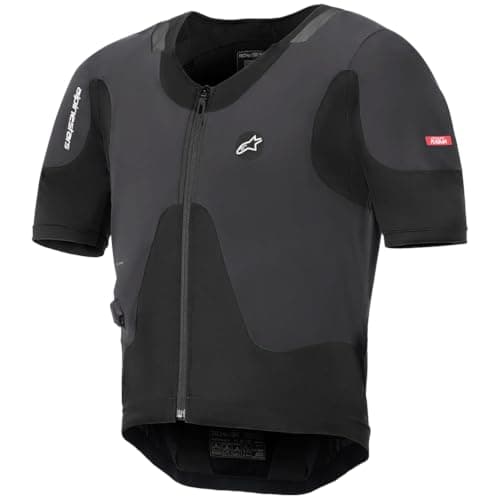
Electronic. A sensor pack and a microprocessor sit in the vest. Alpinestars publishes six sensors on the Tech-Air 3 V2 — three accelerometers and three gyroscopes — and states that the system runs with no external motorcycle connections at all. Nothing clips to the bike. The system decides a crash is happening from motion data alone, which means it can also fire in the crashes where you never separate from the machine, and it fires whether or not you remembered anything. The costs are a battery to keep charged and a much higher price.
The certification surprise
Both mechanisms are certified under the same standard, EN 1621-4, the CE standard written specifically for inflatable motorcycle protectors. That is the number to look for, and all four vests on this page carry it. What is worth knowing before you spend is that the standard has levels, and on this page the levels do not line up with the prices.
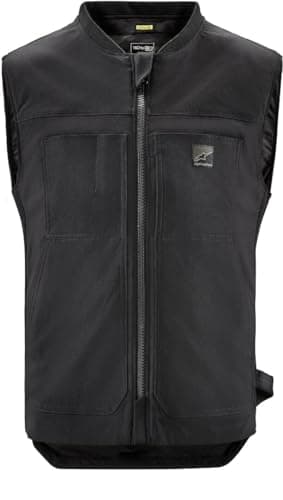
Alpinestars publishes Level 2 impact attenuation for chest and back on the Tech-Air 3 V2. On the more expensive Tech-Air 5 Plasma, the published line is CE certified according to EN 1621-4:2013 Level 1 (Full Back). The cheaper electronic vest is the one with the higher published attenuation level. What the dearer one buys you instead is zones and weight: Alpinestars publishes chest, ribs, back and shoulder coverage for the Tech-Air 5 Plasma at 1,530 g, against 2,660 to 3,040 g for the Tech-Air 3 V2 depending on size. If you are buying the number on the certificate, that matters. If you are buying the vest you will actually keep wearing in August, so does the weight. Neither answer is wrong; they are different questions, and a page that pretends the most expensive option wins every criterion is not being straight with you.
How we compared them
Four criteria, in this order. First, does it fire in the crashes you are likely to have — which for a tethered vest includes the question of whether it was clipped. Second, what the maker actually publishes: the EN 1621-4 level and the zones, not a marketing adjective. Third, what it does on the ninety-nine rides out of a hundred where nothing happens — weight, heat, and whether there is any passive protection inside when the bag has not fired. Fourth, what it costs to own: cartridges, dealer resets, batteries and replacement intervals. Price is a tie-breaker, not a criterion, which is why the cheapest vest here finishes second and the most expensive finishes third.
What EN 1621-4 actually certifies
EN 1621-4 is the CE standard for inflatable protectors, and it is doing more work than a back-protector standard does. It does not only measure how much force an inflated bladder transmits; it also covers the deployment itself — that the system inflates when it should, that inflating does not injure the wearer, and that the protector performs after the gas is in it. Two levels exist, and Level 2 transmits less force than Level 1 in the test, the same relationship you already know from EN 1621-1 and EN 1621-2 armor.
The practical point for a buyer is that the level is stated per zone. "Level 1 (Full Back)" means the back is what was tested to Level 1. "Level 2 for chest and back" means two zones were tested at the higher level. A vest that says only "EN 1621-4 certified" without a level has still been through the standard — Hit-Air states EN 1621-4:2013 for the MLV2 and publishes a coverage map instead of a level — but you are then comparing coverage rather than attenuation, and you should know which one you are doing.
The trigger question is the real one
Every argument about airbag vests eventually reduces to one thing: will the bag be inflated at the moment your shoulder reaches the road. For an electronic vest, that is a question about the algorithm and the battery. For a tethered vest, it is a question about you.
Be unsentimental here. A tethered vest is a superb piece of equipment that is completely inert if the cable is dangling from the handlebar. It is not like forgetting to zip a jacket, where you notice within a mile; a clipped tether feels the same as an unclipped one for the entire ride. Riders who make tethered systems work treat the clip as part of a fixed sequence — gloves, then tether, then ignition, every time, no exceptions — in the same way you learned to do a head check. If that sounds like you, the tethered vests here give you certified protection for a lot less money. If reading that made you wince, take the electronic route and budget for it, because you are buying out of a failure mode you already know you have.
There is a second, quieter difference. A tether fires on separation, so it covers the low-side, the high-side and being launched over the front. It does not cover crashes where you stay on the bike, and an electronic system reading motion data can. How much that is worth depends entirely on how you ride, and no honest page can put a number on it.
Coverage: where the bag actually goes
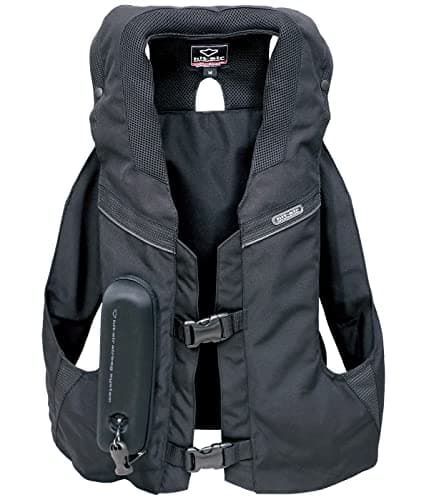
Inflated area is the other half of the purchase, and the four vests here are not covering the same body. Hit-Air publishes the widest map of any of them — the airbag is stored in the neck, back, hip and sides, so a deployment reaches the pelvis and tailbone, not just the spine. Alpinestars publishes chest, ribs, back and shoulders for the Tech-Air 5 Plasma, and chest and back for the Tech-Air 3 V2. Nothing here covers the legs, and only the Hit-Air reaches below the waist.
That is worth sitting with, because hip and tailbone injuries are common and unglamorous, and the most expensive vest on this page does not address them. If your mental image of a crash involves landing on your backside, the widest map is a tethered one.
What it does when it has not fired
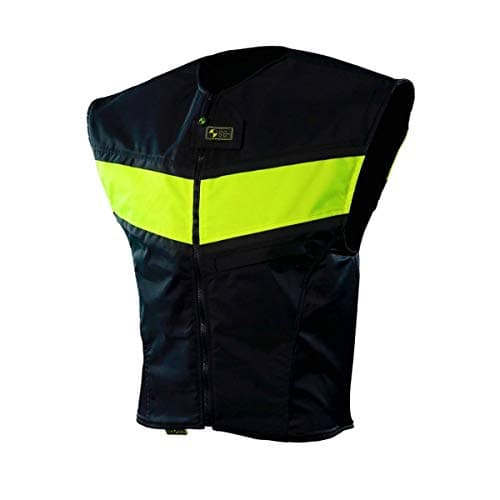
Almost every ride ends with the vest doing nothing, which makes the question of what is inside it when it is deflated a real one. Here only the Airobag Wise answers it: it carries an integrated TRIFLEX back protector rated to EN 1621-2 Level 2, so on an ordinary ride it is still a certified back protector. The others are, in their deflated state, fabric. That is not a criticism of the engineering — it is a genuine difference in what you get for the money, and it is why the cheapest vest on this page outranks the most expensive one.
It also changes what you should own alongside it. If your airbag has no passive protector in it and you ride with a jacket whose back pocket holds a foam pad, you still have an un-upgraded spine on every ride that does not end in a deployment. Our back protector ranking covers the fix, and airbag vest vs back protector is the page to read if you are deciding which to buy first.
Cost of ownership, not just price
A tethered vest is the cheaper thing to live with by a distance. The cartridge is a consumable you swap yourself — Hit-Air publishes 50cc for the small and 60cc for medium and large — and Airobag publishes a re-arm you do in under a minute. There is no battery, so there is no charge cycle and nothing to go flat.
Electronic ownership is a different shape. Alpinestars publishes up to 40 hours of runtime and a four-hour full charge on the Tech-Air 3 V2, and up to 30 hours per charge on the Tech-Air 5 Plasma; both need to be part of your routine the way a phone is. Resetting after a deployment splits the two: Alpinestars describes the Tech-Air 5 Plasma as having a single-canister, user-replaceable inflator behind a quick-release service cover where local law allows it, and certifies the airbag for up to six deployments before replacement, while the Tech-Air 3 V2 goes back to a certified Tech-Air dealer for its cartridge. If you live a long way from a dealer, that is a real consideration and not a small one.
Weight, heat and whether you will wear it
The best airbag is the one on your body. Published weights here run from 1.3 kg for the Airobag Wise and 1.4 to 1.6 kg for the Hit-Air MLV2, through 1,530 g for the Tech-Air 5 Plasma, up to 2,660 to 3,040 g for the Tech-Air 3 V2. The gap between the lightest and the heaviest is more than a kilogram sitting on your shoulders, and in high summer that is the difference between a vest you wear and a vest in the garage.
Layering matters as much as mass. Alpinestars states the Tech-Air 3 V2 can be worn over or under a compatible jacket; the tethered vests here are worn over. Over the jacket is easier to fit around gear you already own and easier to take off at a stop. Under the jacket looks like normal riding kit and keeps the outer shell doing the abrasion job it was rated for. Either way, check your jacket has room — an inflating bag needs volume, and a jacket you have to hold shut over a vest is a jacket that will fight the deployment.
Which one should you buy?
Buy electronic if you will not reliably clip a cable, if you want the highest published attenuation level here, or if you want protection in crashes where you stay with the bike. Within electronic, the Tech-Air 3 V2 is the one we would buy: it publishes the higher level, it costs less than the Tech-Air 5 Plasma and it can go under a jacket. Take the Tech-Air 5 Plasma instead if weight is the thing that decides whether you wear a vest at all, or if shoulder and rib coverage matters more to you than the certificate line.
Buy tethered if the clip will genuinely become a habit, if you want hip and tailbone coverage, or if the electronic price is the reason you currently have no airbag at all. The Airobag Wise is the value answer on this page and the only vest that is still a certified Level 2 back protector when nothing has happened. The Hit-Air MLV2 is the one to take if coverage is the priority and you want the widest published map of the four.
And if none of this fits the budget yet, buy a certified back protector today rather than an airbag in two years. A Level 2 protector you own now beats an airbag you are still saving for, and it is the upgrade every rider should make before anything else on this page.