Most riders who end up on this page have already tried the obvious workaround: buy the smallest men's glove on the rack and hope. Sometimes that works. When it does not, the failure is not about comfort. A glove that is too big turns on your hand when you grip the bar, the knuckle protector drifts off your knuckles, and a loose enough glove can be pulled off in a slide. That last risk is serious enough that the European standard for motorcycle gloves requires an adjustable restraint at the wrist or cuff before a glove can be certified at all.
The size charts make the case better than we can. On the Alpinestars chart, the smallest men's glove, a small, starts at a 7.5-inch hand. The women's Stella range starts a full inch lower: XS covers 6.5 to 7 inches and small covers 7 to 7.5. If your hand measures under 7.5 inches around, there is no men's Alpinestars glove in your size. And the letters shift, too: a women's medium on that chart is 7.5 to 8 inches, which is exactly a men's small. The buying guide below has the full table.
So we ranked women's gloves by asking four questions, in this order:
- Does the maker publish an EN 13594 level, and does it carry KP? The level says the glove passed a motorcycle test. The two letters KP say the knuckle protection passed a separate impact test, which Level 1 does not require.
- Does the maker say the pattern was cut for a woman's hand, and does the size run start small enough? A women's label on a glove that only comes in medium and up helps nobody with small hands.
- What is on the knuckle and the palm, in the maker's own words? KP tells you the knuckle protection passed; it does not tell you what it is made of or whether there is a slider under your palm.
- What weather is it built for? Perforated leather, a waterproof membrane and an insulated winter glove are three different purchases, and pretending one glove does all three is how riders end up with cold, wet hands.
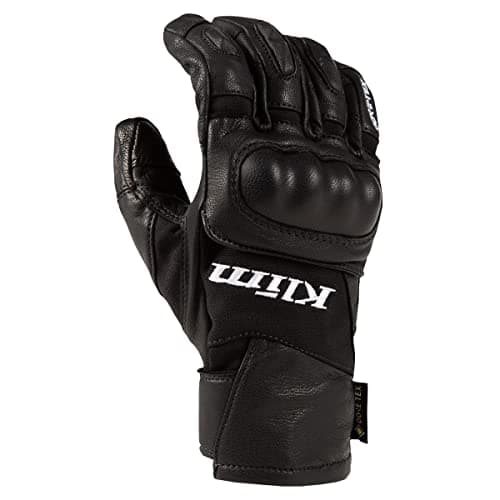
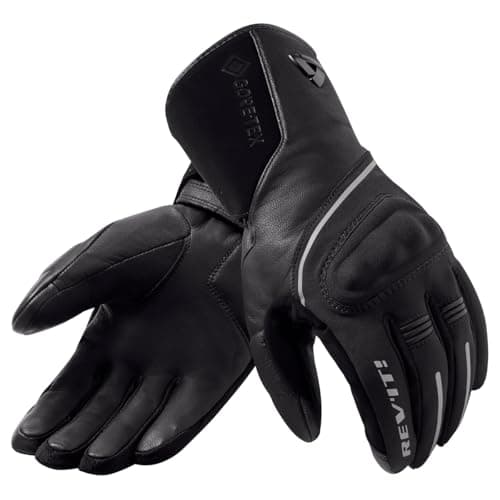
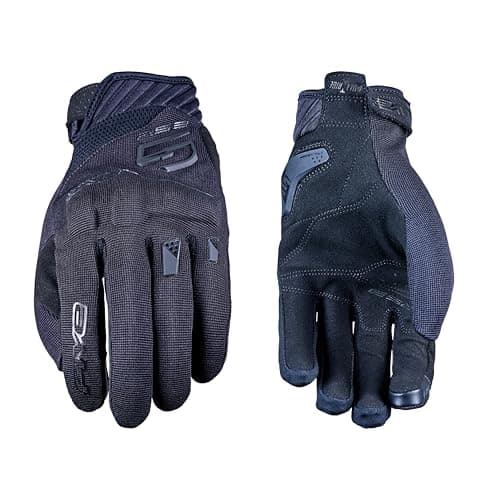
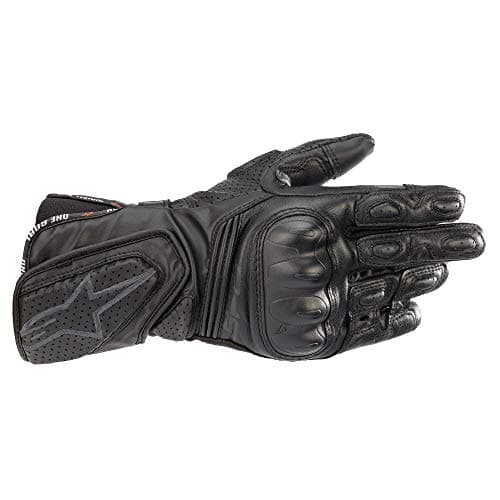
Price comes last, and it still matters. The Alpinestars Stella SP-8 V3 is our top pick: the women's version of the glove that leads our main gloves ranking, in full-grain leather with a hard knuckle, at a mid-range price. The KLIM Women's Adventure GTX Short is the waterproof pick, with bonded GORE-TEX layers built for feel on the controls. The REV'IT! Stratos 3 GTX is the winter glove, insulated as well as waterproof. And the FIVE RS3 Evo Woman is the budget and hot-weather pick, and the proof that a certified women's glove does not have to be expensive.
One thing you should know before you read the cards: all four publish Level 1 KP. None of the women's-pattern gloves we could verify in stock on Amazon for this ranking published Level 2. Level 1 is the level designed around low ergonomic penalties, which suits most road riding, and the next section explains exactly what you do and do not get from it.
We have not tested these gloves, crash-tested them or worn them on a track, and we do not run a lab. Every spec below is quoted from the maker's own product page or, where that page would not load for us, from a named retailer's spec sheet. Every source is linked at the bottom of the page. Where a maker does not publish something, the card says so instead of guessing.
Level 1 KP: what the label actually tells you
EN 13594:2015 is the European standard for motorcycle gloves, and it has two levels. SATRA, a test house that tests gloves to it, describes Level 1 as gloves "designed to give protection while having low ergonomic penalties" and Level 2 as gloves "providing greater protection than level 1," adding that "there may however, be weight and restriction penalties included." That is the honest trade in one sentence: Level 2 protects more, and it usually costs you some feel.
The part most buyers miss is the two letters after the number. Per SATRA, impact protection is optional at Level 1 and mandatory at Level 2. So a glove labeled with a plain 1 passed the glove tests, but its knuckles were not impact-rated. A glove labeled 1 KP had its knuckle protection pass a separate impact test on top. Every glove on this page carries KP. When you shop for anything else, look for those two letters beside the motorcycle pictogram and the level number on the label inside the cuff.
The other differences between the levels, again from SATRA: Level 1 tests cut resistance on the palm materials, while Level 2 tests every material in the glove except the fourchettes between the fingers. The adjustable wrist restraint has to hold 25 N of pull at Level 1 and 50 N at Level 2. And Level 2 requires a cuff of at least 50 mm, which in practice means a gauntlet. If you ride track days or ride fast on a sportbike, that is the rating to look for, and you should read the label in the glove before you buy it rather than trust the listing.
For road riding, commuting and touring, Level 1 KP with a restraint that actually cinches is a genuine motorcycle glove. It is also the rating every pick here shares, which is why the rest of this guide is about the things the label cannot tell you. For the full glove decision beyond certification, our how to choose motorcycle gloves guide works through it in order.
Women's sizes are not men's sizes with a different name
Here is the Alpinestars glove chart laid out side by side. Alpinestars measures hand circumference, and the same measurement lands on a different letter depending on which line you buy from:
| Hand circumference | Women's (Stella) size | Men's size |
|---|
| 6.5 to 7 in | XS | None |
| 7 to 7.5 in | S | None |
| 7.5 to 8 in | M | S |
| 8 to 8.5 in | L | M |
| 8.5 to 9 in | XL | L |
Two things fall out of that table. First, the bottom two rows have no men's glove at all, so a rider with a hand under 7.5 inches has no workaround inside that brand. Second, the letter on a women's glove is one size larger than the men's letter for the same hand. On that chart, a rider who wears a men's small and orders a women's small has bought a glove a size too tight.
The letters do not carry between brands either. Take the men's glove charts from three makers on this page. An 8.3-inch hand is a medium at Alpinestars (8 to 8.5 inches), a medium at REV'IT (8.1 to 8.7) and a small at KLIM (8.25 to 8.6). Same hand, two different letters, three brands. The only safe rule is to measure your hand and read the chart for the exact brand you are buying, every time.
How to measure, in the words the Alpinestars and KLIM charts use: wrap a cloth tape around your hand behind the knuckles, not including the thumb, keeping it snug. Measure both hands and use the larger number. The REV'IT and KLIM charts also list hand length, measured from the base of the palm where it meets the wrist to the tip of the middle finger. If your circumference sits on the line between two sizes, the length column is the tie-breaker on the charts that publish one. Our glove sizing guide covers the fit checks once the gloves arrive.
Knuckle and palm: read what each maker actually says
A KP rating tells you the knuckle protection passed an impact test. It does not tell you what the protector is made of, and the four picks here give four different answers. Alpinestars publishes a molded hard knuckle protector. KLIM publishes a carbon fiber knuckle guard with 5mm of XRD impact foam underneath it. REV'IT uses its SEESOFT knuckle protection. FIVE puts monobloc PU shells under the Spandex upper, over both the knuckles and the metacarpals. All four passed the same KP test, and they will not feel alike on your hand.
The palm varies more. A palm slider is a hard, low-friction patch that lets a sliding hand skate instead of catching. The Stratos 3 spec sheet lists a Temperfoam palm slider with PWR|Shield reinforcement, and FIVE publishes a TPR protective shell on the palm. KLIM publishes a 5mm XRD palm pad, which is impact foam and a different job from a slider. Alpinestars publishes Arshield reinforcement and a synthetic suede palm and landing zone, without using the word slider. None of this is graded by EN 13594, which is exactly why it is worth reading past the certification line.
Two smaller details are worth a look. Alpinestars' patented third and fourth finger bridge links those two fingers, and the maker says it prevents seam failure. And all four close with hook and loop at the wrist, which is the adjustable restraint the standard asks for. Whatever you buy, cinch it before every ride: the restraint only works if it is done up.
Waterproof gloves: bonded layers or a liner
Two of the picks use GORE-TEX, and they are built differently. KLIM publishes "fully bonded glove layers for optimal dexterity." GORE-TEX describes bonded construction as layers "tightly bonded together for a layered construction that eliminates friction and movement between layers," and contrasts it with "the usual loose layers within gloves." The benefit GORE-TEX claims for it is "a direct feel and intuitive grip," which is the thing a waterproof glove usually gives up.
REV'IT lists a GORE-TEX Z-liner with 3M Thinsulate G insulation in 300g and 80g weights, and it does not describe its layers as bonded. So the trade is simple. The KLIM is the rain glove for mild days, when you want to feel the clutch. The REV'IT is the rain glove for cold days, when warm fingers matter more than feel.
The other two picks have no membrane at all. Perforated leather and Spandex are for dry days, and neither is sold as a rain glove. If cold is your main problem, our winter gloves ranking goes further, and our heated gloves ranking includes a women's-pattern heated glove. Read its certification caveat first: no heated glove we could find publishes EN 13594.
Why most of Amazon's women's gloves are not on this list
Search Amazon for women's motorcycle gloves and much of what comes back publishes no standard at all. We are not calling those gloves unsafe. We are saying the maker has not published a test result, so you are buying a description instead of a rating. We checked several on the makers' own pages before ruling them out. Kemimoto's two women's leather gloves describe carbon fiber knuckle shells and padding, with no EN 13594 level. Cortech's women's Revo RR V2, Revo ST V2 and Manix ST pages list real hardware, including carbon or TPU knuckle protectors, SuperFabric reinforcement and, on the Manix ST, a TPU palm slider, but no certification.
"Carbon fiber knuckle" on a listing is a material. "1 KP to EN 13594:2015" is a test result. Even at the budget end of the market there is a certified women's-pattern glove, the FIVE, which is why we held the line instead of ranking a glove on its description. A published level does not make a glove perfect. It means someone put the finished glove through a motorcycle test, and the maker is willing to print the result.
Which one should you buy?
Buy the Alpinestars Stella SP-8 V3 if you want one pair for most of the riding season. It has full-grain leather, a hard knuckle, a finger bridge and the most complete certification line here, with a women's size run that starts at XS. Buy the KLIM Women's Adventure GTX Short if you ride through rain and still want to feel the controls, and you are willing to pay the most for it. Buy the REV'IT! Stratos 3 GTX if your riding runs into the cold months, because it is the only insulated glove here. And buy the FIVE RS3 Evo Woman if you ride in the heat, if this is your first pair, or if the budget is tight. It is the cheapest way we found into a certified women's glove with KP knuckles.
Many riders end up with two pairs, and that is the honest answer here too: a summer or three-season glove (the FIVE or the Alpinestars) and a cold-and-wet glove (the REV'IT). Whatever you choose, match it to the rest of your kit. Our women's jacket ranking applies the same published-certification test to jackets, and our women's helmet ranking does the same for the helmet.