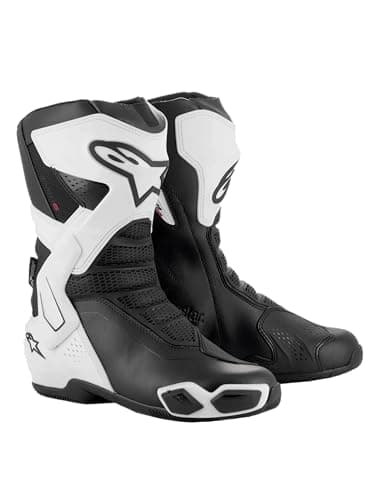
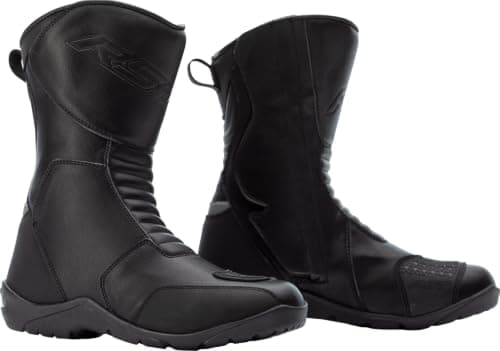
The case for a women's motorcycle boot is not the one you might expect. With gloves, the argument is simple: the smallest men's size stops where many women's hands start, and our women's gloves ranking is built on that chart. Boots are different. The men's Alpinestars SMX-6 V3 Drystar runs from EU 36 to 50, and the women's Stella version runs from 36 to 43, so a small foot has a men's boot available. What the women's boot changes is the last: the shape of the heel, the instep and the calf the boot is built around. Alpinestars calls it a dedicated female fit, and a boot that grips your heel instead of letting it lift is a boot whose ankle protection stays over your ankle in a crash.
The second thing that changes is the number on the box, and this is the part that catches people out. On Alpinestars' charts, an EU 39 is a men's US 6 and a women's US 8. Sidi's table says an EU 39 is a US 6 and puts a US 8 at EU 41. So a woman who wears a US 8 is a 39 in one women's boot on this page and a 41 in another, two full sizes apart, and both makers are right by their own charts. The sizing section below shows how to get around that with a tape measure instead of a conversion.
We ranked women's boots by asking four questions, in this order:
- What does the maker publish under EN 13634, in its own words? Every boot here is certified. One maker prints a four-digit result, two name the revision year, one names the tests, and one leaves the line to its retailer. That ladder is the ranking.
- Is it built on a women's last, and does the maker say so? A men's boot in a small size and a women's boot are not the same object, and a maker that has done the work usually says it in writing.
- What is on the ankle, the shin and in the sole, by name? Ankle impact protection is an optional property under the standard, so a certificate does not promise it. A named ankle protector, a named shin plate and a named anti-twist insert do.
- What weather is it built for? Four of the five carry a waterproof membrane. The fifth is a dirt boot and does not pretend otherwise.
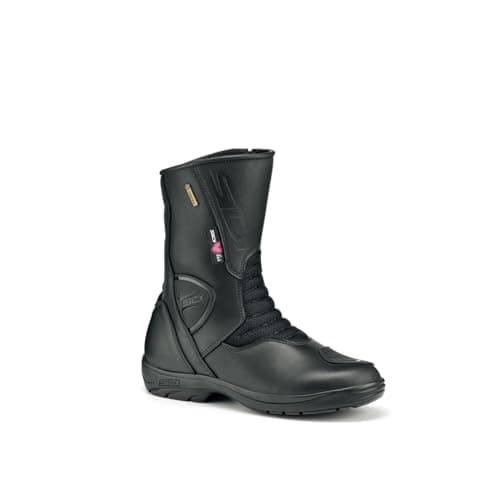
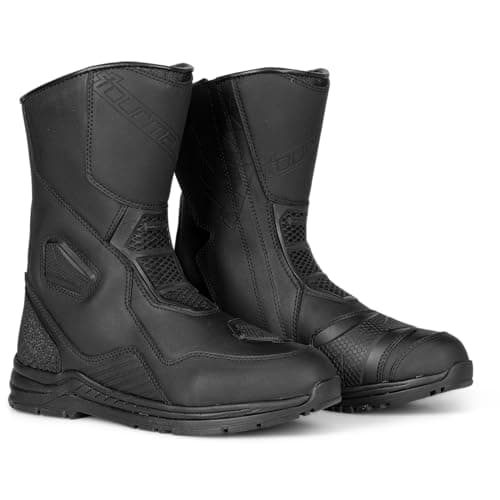
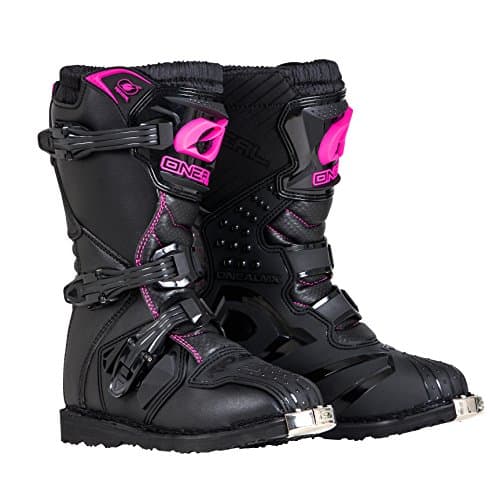
Price comes last, and it still matters. The RST Axiom CE Ladies Waterproof is our top pick because it is the only boot here whose maker publishes a per-test CE rating, 2122, and it does so at a mid-range price with a shin protector and an anti-twist midsole on the sheet. The Alpinestars Stella SMX-6 V3 Drystar is the sport-touring pick with the longest hardware list on the page and the only written female-fit statement, at the highest price. The Sidi Gavia Gore-Tex Women's is the touring boot with a real Gore-Tex membrane and protection on both sides of the ankle. The Tourmaster Women's Helix Waterproof is the budget touring boot, and the one whose certification line names the tests. And the O'Neal Women's Rider is the off-road and adventure pick, with the widest size run here and the weakest certification paper trail, which its card says plainly.
We have not tested these boots, crash-tested them or worn them on a track, and we do not run a lab. Every spec below is quoted from the maker's own product page or, where that page carries no spec sheet, from a named retailer's page, and every source is linked at the bottom. Where a maker does not publish something, the card says so rather than filling the gap.
Why your EU size changes between women's boots
Motorcycle boots are sold in EU sizes, and the US number printed next to the EU number is the maker's conversion, not a measurement. Two makers on this page convert the same EU size to different US sizes, and the gap is not small.
| EU size | Alpinestars men's chart | Alpinestars women's chart | Sidi chart (unisex) | Sidi heel-to-toe |
|---|
| 37 | US 4 | US 6 | US 4.5 | 23.2 cm |
| 39 | US 6 | US 8 | US 6 | 24.5 cm |
| 41 | US 7.5 | US 9 | US 8 | 25.8 cm |
| 43 | US 9 to 9.5 | US 11 | US 9.5 | 27.2 cm |
Read across the US 8 row. At Alpinestars, a women's US 8 is an EU 39. At Sidi, a US 8 is an EU 41. Alpinestars' own men's chart puts an EU 39 at a men's US 6, so the women's chart is not a typo: the company converts the two lines differently on purpose. If you have been wearing men's boots and know your EU number, that number carries to a Stella boot; if you only know your US size, it does not. RST sidesteps the whole thing by selling the Axiom in UK ladies sizes 3 to 8, and Tourmaster and O'Neal sell in women's US sizes, so on a five-boot page you are looking at four different sizing systems.
The way through is the one Sidi prints under its chart: measure the length of your foot in centimeters from the heel to the big toe, and buy the EU size whose heel-to-toe figure matches. Sidi publishes that figure for every size, from 22.5 cm at EU 36 to 31.8 cm at EU 50, and a centimeter is a centimeter at every brand. Then check the fit the way our how to choose motorcycle boots guide describes: snug through the heel with room to wiggle your toes, and no lift at the heel when you walk. A boot whose heel lifts is a boot whose ankle armor is moving.
EN 13634 is a gate, and one maker here climbs past it
EN 13634 is the CE standard for motorcycle footwear. It rates four things separately, upper height, impact abrasion resistance, impact cut resistance and transverse rigidity, each at Level 1 or Level 2, and then, according to SATRA, the test house, leaves five properties optional for the maker to claim or not: impact protection, resistance to water penetration, fuel oil resistance, slip resistance and water vapor permeability. In plain English, a certified boot has not necessarily been tested for ankle impact protection, and "certified" never means "waterproof."
Every boot on this page is certified, so the ranking comes down to how much each maker tells you. RST prints a CE certification rating of 2122 for the Axiom. Read in the standard's usual order, that is Level 2 upper height, Level 1 abrasion, Level 2 cut resistance and Level 2 transverse rigidity, though RST does not label the digits, so treat that as our reading rather than the maker's claim. Either way, it is the only per-test result on the page. Alpinestars and Sidi publish "CE certified to EN 13634:2017," naming the revision and stopping there. Tourmaster goes one step further in a different direction and names the tests: "impact, abrasion, and transverse rigidity tested, CE certified to EN 13634:2017." And the O'Neal line, "Meets EN13634 standard," appears on RevZilla's spec sheet but not on O'Neal's own product page, which lists the plates, the shank and the buckles and no standard at all. That is why the O'Neal ranks last on certification despite being one of the more heavily armored boots here.
Our main boots ranking applies the same gate to the men's catalog, and our riding shoes ranking shows what the per-test digits look like when two other makers publish them.
The hardware to look for after the certificate
Ankle protection, on both sides if you can get it. Because ankle impact protection is optional under the standard, look for it by name. Alpinestars lists a TPU lateral ankle brace and describes it as single-sided. Sidi lists an external outer ankle panel plus internal inner ankle protection, which is both sides. Tourmaster lists dual-density molded ankle protectors. RST lists integrated ankle protection. A boot with a certificate and no named ankle protector is protecting your ankle with the upper.
A shin plate, if you ride anywhere fast. Only two of the five name one: the Alpinestars' race-derived TPU shin plate and the RST's integrated shin protection. The O'Neal's injection-molded plates do the same job on the dirt. The Sidi and the Tourmaster do not list one, which is common in touring boots and worth knowing before you buy one for a sport bike.
Something rigid in the sole. The injury a boot is most exposed to is your foot being twisted or crushed under the bike. The RST answers that with a polycarbonate anti-twist midsole, the O'Neal with a metal shank insert, the Alpinestars with a medium-stiffness sport sole. Tourmaster and Sidi do not name an insert. Our short vs tall boots comparison explains why sole stiffness and shaft height are the two numbers that decide how much of you a boot really covers.
Toe and heel, and the shift pad. Reinforced toe and heel cups take the load when the bike pins your foot; a shift pad is what stops the lever chewing through the top of the boot in a season. RST, Sidi and Tourmaster all name both. Alpinestars adds replaceable, screw-in toe sliders, which is the sport tell on this page.
Waterproof, and which membrane
Four of the five boots carry a membrane, and they are not the same membrane. The Sidi uses Gore-Tex. The Alpinestars uses Drystar, its house membrane. The RST uses SinAqua and the Tourmaster a 3-layer Aqua-barrier, both house names. None of the four publishes a waterproof rating in millimeters for these boots, so we cannot rank the membranes against each other, and we will not pretend to. What we can say is that a boot with a membrane runs warmer than one without, which is why the O'Neal, a vented dirt boot with no membrane, is the only pick you would want on a hot trail day. Our waterproof boots ranking covers the membrane question in more depth.
Why most of Amazon's women's boots are not on this list
Search "women's motorcycle boots" on Amazon and most of the first page is leather fashion boots with a motorcycle in the name. We checked the makers' own pages for the ones that looked like riding gear. Cortech's Women's Apex RR Waterproof is the closest miss: a real riding boot with a HiPora 3-layer membrane, molded TPU shin guards, dual-density ankle protectors and an anti-twist nylon midsole, sold specifically for women riders, and no CE or EN 13634 certification stated anywhere on its page. We are not calling it unsafe; the hardware list reads like the boots above it. It is not ranked because the whole point of this page is what the maker is willing to put in writing, and Cortech did not. For the Harley-Davidson Footwear and Milwaukee Leather women's boots that fill the rest of the results we could not find a published motorcycle standard at all, and the unbranded "CE certified" riding shoes around them name no standard on their listings.
Two boots were real, certified and in stock, and still left off. The Alpinestars Stella SMX-1 R V2, a short women's boot, was dropped only to keep one Alpinestars pick on a five-boot page; if you want the Stella fit without the tall shaft, it exists. And the Fox Racing Women's Comp, an MX boot, was down to a handful of sizes when we checked, which is not a boot we can send you to buy.
Which one should you buy?
Buy the RST Axiom CE Ladies Waterproof if you want the boot that tells you the most for the least: a per-test CE rating, a shin protector and an anti-twist midsole, waterproof, at a mid-range price. Buy the Alpinestars Stella SMX-6 V3 Drystar if you ride sport or sport-touring and want the most named protection on the page on a last the maker built for you, and the price does not stop you. Buy the Sidi Gavia Gore-Tex Women's if your miles are long and wet and you want Gore-Tex and ankle protection on both sides, and your foot is not wide. Buy the Tourmaster Women's Helix Waterproof if the budget is real and your foot is a women's US 6 to 10: it is certified, it names its tests, and it carries the longest warranty here. And buy the O'Neal Women's Rider only if the ride is dirt or adventure: on the trail it is the most boot for the money on this page, and on a commute it is the wrong tool. Whichever you choose, measure your foot in centimeters first, and pair it with the rest of the kit from our women's jackets and women's helmets rankings.