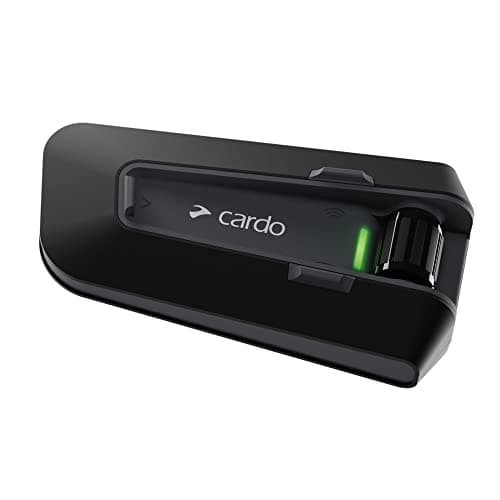
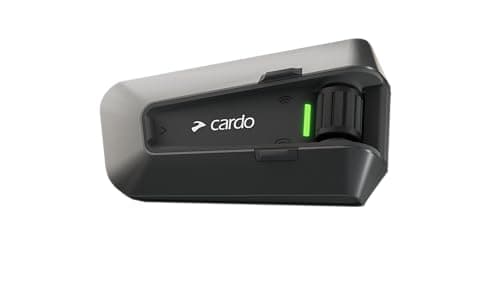
This is the rare comparison where the honest answer is short, and the manufacturer says it out loud. On Cardo's own Packtalk Neo page, the company states that the difference between the two units is the mounting: the Packtalk Edge uses a magnetic Air Mount, and the Packtalk Neo uses a clickable mount. Everything the rest of the internet argues about — mesh generation, speaker quality, waterproofing, battery — is published identically for both.
Both units run Cardo's 2nd-generation DMC mesh, both pair over Bluetooth 5.2, both carry 40mm JBL speakers, both are IP67 rated, both publish 13 hours of talk time with a fast charge that returns two hours of talking from twenty minutes on the cable, both do Natural Voice Operation, both take over-the-air updates through the Cardo Connect app, and both connect groups of up to 31 riders at a published range of up to 1.6 km / 1 mile between riders. That is not our summary of a marketing page — those are the figures Cardo prints on both product pages, and we have linked them below.
So the decision is two questions. Do you take the unit off the helmet often? The Air Mount is a genuine convenience if you do — it snaps on and off with a gloved hand, where a cradle wants a deliberate slide-and-click. And is a third year of warranty worth the price gap to you? Cardo publishes a 3-year warranty on the Edge and a 2-year warranty on the Neo. For most riders who mount a unit once and leave it there, the Neo is the smarter buy and the money saved is better spent on a decent set of earplugs — which will do more for your ears over ten years than any speaker upgrade.
If you are still deciding between mesh and plain Bluetooth at all, read Bluetooth vs mesh first — that choice matters far more than which of these two boxes you end up with. And if you have not settled on a brand, our Cardo vs Sena comparison is the level above this one.
What the Air Mount actually changes
Cardo calls the Air Mount a patented magnetic mount, and the practical difference is simple: the Edge snaps to the baseplate and pulls straight off, while the Neo slides into a cradle and clicks. In a heated garage neither is hard. At a gas stop in November, in gauntlet gloves, with the unit needing to come inside so it does not sit in the cold overnight, the magnet earns its keep.
Two consequences worth knowing before you buy. First, the Air Mount uses its own glue plate or clamp — it is not the same baseplate as older Cardo cradles, so a second-helmet kit for an Edge is a different part number from a second-helmet kit for a Neo. Second, if you have an older Cardo already glued to a helmet, that mount will not accept an Edge. Neither of those is a defect; they are just the sort of thing that turns a cheap upgrade into a not-cheap one.
Mesh, and why the generation matters more than the model
Both units run DMC 2nd generation, which is the part that actually determines whether the intercom holds together on a real ride. A Bluetooth intercom chain is a chain: one rider drops out of range and the riders behind them can lose the link. Mesh is a self-healing web — riders join, leave and drift without you re-pairing anything, and the network routes around the gap. Cardo publishes 31-rider groups and up to 1.6 km / 1 mile between riders for both the Edge and the Neo.
One thing no spec sheet tells you: mesh does not cross brands. Cardo DMC talks to Cardo DMC. If the people you actually ride with are all on Sena, buy Sena — a technically better unit that cannot join the group is a worse unit. That is the single most common expensive mistake in this category, and it is covered in more depth in how motorcycle intercoms work.
Sound: identical hardware, identical result
Both units ship the 40mm JBL speaker set and Cardo's redesigned sound processing. There is no published acoustic difference between them, we have not measured either one, and we are not going to invent a distinction to make this section longer. If audio quality is the reason you are shopping, the meaningful upgrade path inside Cardo's range is the 45mm JBL audio set, not the choice between these two bodies — and the honest ceiling on in-helmet sound is your helmet, not your speakers. A quiet lid from our quietest helmets ranking does more for perceived audio quality than any driver upgrade, because you stop fighting wind noise for volume.
Which one should you buy?
Buy the Packtalk Neo unless you have a specific reason not to. It is the same mesh, the same sound and the same waterproof rating for less money, and the two-year warranty is not short by the standards of this category.
Buy the Packtalk Edgeif you genuinely move one unit between two helmets, if you strip the unit off the bike every time you park in the city, or if the extra warranty year is worth the difference to you. Those are real reasons. "It is the newer one" is not — by Cardo's own description, the internals are the same.