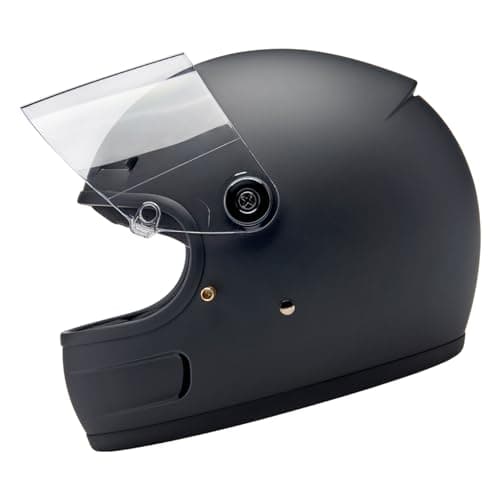
Retro is the corner of the helmet market where looks got there first and the safety label had to catch up. Search for a vintage motorcycle helmet and you will get properly certified full-faces from established makers sitting in the same results grid as shiny novelty shells that carry no standard at all, sold with a line about not being intended for highway use buried three scrolls down the listing. So we ranked this category the way we rank every other one on this site: by what is actually printed on the certification label, then by shell count, shell material and published weight. The look is the reason you are here. It is not a criterion.
Every helmet on this page is a full-face with a chin bar, and that is deliberate. The chin bar covers the part of the helmet that takes a large share of serious impacts, and a retro shape does not change that arithmetic. If the version of the retro look you want is the open 3/4, we ranked those separately and on the same criteria in our best open-face helmets guide — go there instead, and go there knowing what you are giving up.
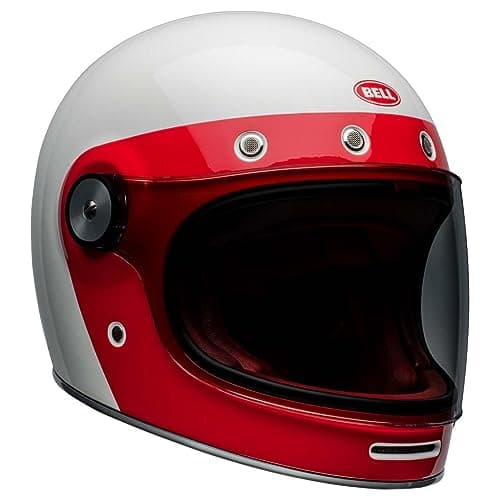
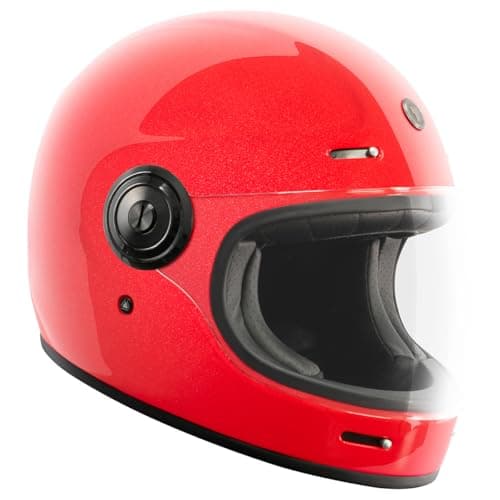
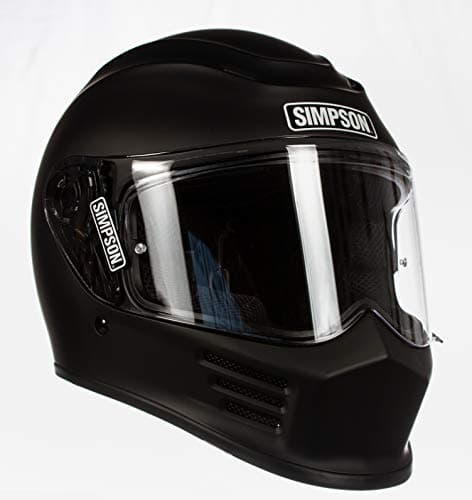
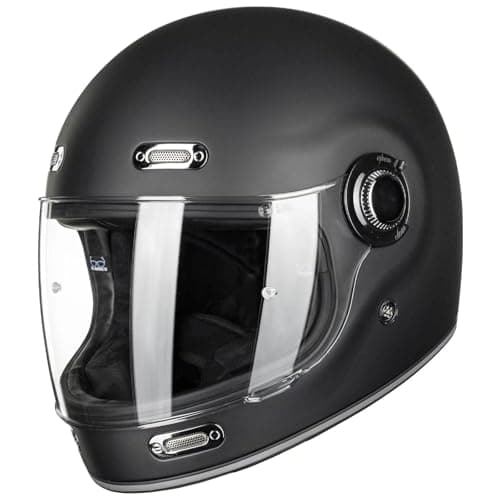
The Biltwell Gringo SV takes the top spot for one reason that has nothing to do with styling: it is the only helmet here that publishes both US DOT FMVSS No. 218 and ECE 22.06, the current European revision. The Bell Bullitt is the lightest and the best-finished, but Bell does not print an ECE revision on the standard model. The TORC T-1 Newport is the value story — a 100% fiberglass shell with real published gram weights at the lowest composite price in the category. The Simpson Speed Bandit buys you the widest view on the page and an ECE revision that is one generation behind. And the ILM Z503 is the floor: cheap, DOT-claimed, and worth reading the fine print on.
We have not crash-tested any of these helmets and we are not going to imply otherwise. What you are reading is a certification-and-spec comparison built from manufacturer pages and published retailer spec sheets, which is the honest version of this exercise and, as it turns out, the version that actually separates these five. Our DOT vs ECE vs Snell explainer covers what each label tests for, and how to read a helmet certification sticker shows you where to find it on the helmet in your hands.
Certification first, because retro is where novelty helmets live
Novelty helmets — the thin shells sold as decorative, with the not-for-road-use disclaimer in the listing — cluster in exactly two categories: half helmets and vintage-look lids. That is not a coincidence. A novelty shell is cheap to mold, and a retro silhouette is the one shape where a thin, low-profile shell does not immediately look wrong. So the first filter on this page was ruthless: no helmet gets ranked unless a manufacturer or a retailer spec sheet states a real standard. We applied the same filter to the other half of that problem in our best half helmets ranking, which also walks through the exact label wording the federal regulation requires.
Beyond that floor, the difference is how specific the maker is willing to be. Biltwell writes it out in full — US DOT FMVSS No. 218 compliant, ECE 22.06 certified — and even names the revision in the product titles. Simpson publishes DOT FMVSS 218 and an ECE certification, but the revision on record is 22.05, the standard that ECE 22.06 replaced. Bell and TORC both say DOT and ECE without printing a revision anywhere we could find, which is not the same thing as failing — it just means you are trusting the word rather than the number. ILM goes softest of all, describing the Z503 as designed to meet FMVSS 218 and DOT safety standards. We ranked accordingly, and we said so on every card. If the distinction between the ECE revisions is new to you, our ECE 22.06 explainer walks through what the newer test battery added, including oblique impacts.
Shell count matters more on a small retro shell than on a modern one
Every helmet maker faces the same choice: tool one shell and vary the internal foam to cover XS through 2XL, or tool several shells so each one is built around a narrower band of head sizes. One shell is far cheaper. It also means a small head ends up inside a large shell packed with thick foam, which sits high, looks bulbous and puts more mass further from your skull.
On a retro helmet that trade-off is worse than usual, because the entire visual appeal of the category is a low-profile shell that sits close to the head. Pad a big shell down two sizes and you have destroyed the exact thing you were paying for. Which is why the shell counts here matter: the Gringo SV uses three shells and five separate EPS liners, the Bullitt three shells (XS–SM, MD–LG, XL–2XL), the T-1 Newport three shells and three EPS sizes, and the Speed Bandit three shells. ILM publishes no shell count for the Z503 at all, which usually means one. Measure your head before you shop — our sizing guide takes two minutes and a tape measure — and check your interior shape against helmet head shapes, because the T-1 Newport is a medium-oval-only shell and that will not suit every head.
Shell material, and the weight it actually buys
This category splits cleanly down the middle. The Bell Bullitt uses a fiber composite shell and publishes 3.24 lb. The TORC T-1 Newport uses a 100% fiberglass shell and publishes 1,450 ±50 g in XS–M and 1,550 ±50 g in L–XXL, which lands in the same range. The Biltwell Gringo SV uses an injection-molded ABS shell and publishes 3.69 lb — call it 200 g heavier than the composites, which is real and which you feel in your neck at the end of a long day. The Simpson Speed Bandit is thermo-injected polycarbonate and publishes no weight at all, and the ILM Z503 is ABS over EPS, also with no published weight.
Composite does not mean safer. A polycarbonate or ABS helmet has to clear the same DOT and ECE battery a composite one does, and the Gringo SV clears a more demanding one than either composite here. What composite buys is the same certified performance at lower mass. That is a comfort and fatigue argument, not a protection argument, and we would take the heavier helmet with the better label every time — which is exactly how this page is ordered. Our are expensive helmets safer guide goes further into what the premium on a shell actually pays for.
Eye protection: flat shield, bubble shield, or nothing
Retro helmets treat the visor as a styling decision, so check what is in the box before you order. The Gringo SV ships with a CE-certified injection-molded polycarbonate shield, anti-fog and anti-scratch treated, hinged with detents so you can ride it cracked open. The Bullitt includes a clear flat shield and sells its signature bubble shield separately. The Speed Bandit has the widest eye port on this page with a four-detent locking shield, and takes a Pinlock insert sold on its own. The T-1 Newport has a lockable anti-scratch, fog-resistant shield. The ILM Z503 has an enlarged visor with a side lock and states Pinlock compatibility.
Two things worth knowing. First, an anti-fog coating is not a Pinlock lens — a Pinlock is a second inner lens sealed against the shield, and it is the only fog fix that reliably survives a cold morning in traffic. Only the Simpson and the ILM mention Pinlock here. Second, the bubble shields that define this look are style pieces with real optical compromises at the edges, and a heavily tinted one is illegal to ride behind at night in most states. Budget for a clear shield you can actually see through in the dark.
What the retro look really costs you
Be clear-eyed about the trade. A retro shell is designed around a shape from the 1960s and 70s, not around a wind tunnel, and the modern conveniences you get on a touring lid mostly are not here. None of these five publishes an internal drop-down sun visor. None publishes a noise figure, and neither do we — we have no measured acoustic data on any helmet and will not invent any. Ventilation is metal mesh and passive ports rather than the sealed, switchable systems on a modern sport-touring helmet. Nothing here comes with a comms unit built in, though the Bullitt, the T-1 Newport, the Speed Bandit and the Gringo SV all publish speaker pockets or ear recesses for one.
If quiet is the spec you actually care about, buy from our quietest motorcycle helmets ranking instead and accept a modern shape. If you want the look but with a chin bar that lifts and a sun visor built in, the modular options in our best helmets for cruisers ranking are the closest compromise. And whichever you buy, wear earplugs — that advice does not change with the decade a helmet is styled after.
One more thing worth saying out loud, because it is usually the real reason someone is on this page: the helmet is following the bike. If you are partway through a period-correct build and want to see what one honestly costs in parts, fabrication and hours, our editor kept a full ledger for his 1972 Honda CB750 K2 — top-end rebuild, custom oil reservoir, powder coating, keyless wiring — in the CB750 cafe racer build log at Steve's Outpost, photographed stage by stage and finished with the honest reason he sold it before it was done.
Which one should you buy?
Buy the Biltwell Gringo SV if you want the strongest certification in the category and can live with the weight — it is the only retro helmet here that publishes both DOT FMVSS 218 and the current ECE 22.06, and three shells with five EPS liners is a genuine fit advantage. Buy the Bell Bullitt if finish and low mass matter most and the missing ECE revision does not bother you; nothing else here feels like it. Buy the TORC T-1 Newport if you want a fiberglass shell and published weights without the premium — it is the best value on this page by a distance, provided a medium-oval interior suits your head.
Buy the Simpson Speed Bandit if the shape is the point and you want the widest possible view out of a retro lid, accepting an ECE 22.05 certification and no published weight. Buy the ILM Z503only if the budget genuinely stops there — and if it does, read ILM's certification wording first, then compare it against the certified budget lids in our best budget helmets ranking, several of which cost about the same and print a harder standard. A certified helmet you can afford beats a beautiful one you cannot.