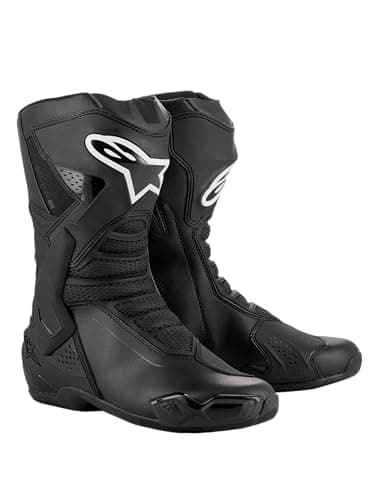
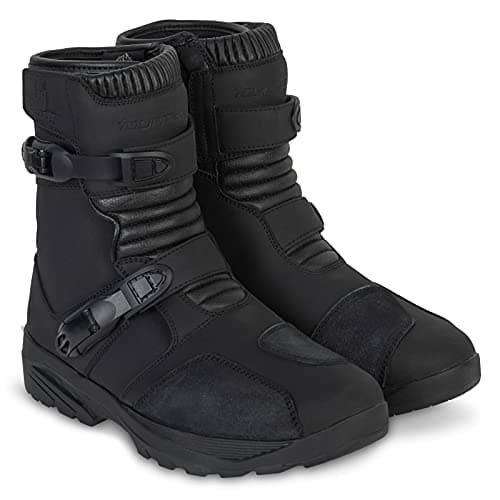
For most new riders the first pair should be the Tourmaster Break Trail WP: a mid-height waterproof boot with dual-density molded ankle protectors, an anti-twist midsole and a hook-and-loop top closure that fits over jeans, at roughly half the price of a premium pair. It is for the rider who wants real protection on every ride without a race boot's stiffness or price. If you already know you will ride a lot, the Alpinestars SMX-6 V3is the better long-term buy — CE certified to EN 13634, taller, and the boot we rank first on the site overall.
There is one thing worth understanding before you spend anything, because it decides the purchase more than any spec does. The boot that protects you is the boot you put on.A new rider's first pair is usually bought for the worst case and then abandoned within a month, because it is stiff, it is awkward to walk in, and it does not come off at the office. What replaces it is sneakers, which protect nothing. So a first boot is a compromise on purpose: enough ankle structure and shin cover to matter, little enough bulk that it stays in the rotation. Every ranking below is built on that trade, which is why the stiffest, most protective boots on this site are not at the top of this particular page.
The other thing to know is what a boot is actually for, and it is not the dramatic crash. The classic motorcycle foot injury is low-speed and unglamorous: the bike tips at a standstill, lands on your foot, and crushes it sideways. That is what transverse rigidity — one of the four properties EN 13634rates — is measuring, and it is the reason a tall leather work boot is already a huge improvement on a trainer, and a certified riding boot is better still. Our do you need motorcycle boots guide takes the whole question apart if you are not convinced yet.
What a first pair of boots needs
- Ankle protection you can point at. A molded or dual-density protector over the ankle bone on both sides, not just padding. Tourmaster publishes dual-density molded ankle protectors on the Break Trail; Alpinestars publishes ankle armor and a torsion-controlled sole on the SMX-6 V3.
- A sole that resists twisting. An anti-twist or torsion-controlled midsole is what stops an ankle rolling sideways under the weight of the bike. Tourmaster names a uni-directional anti-twist nylon midsole; this is a real structural feature and makers who have it say so.
- A shift pad and a reinforced toe. Mundane and worth money: without them the first thing to wear through is the top of your left boot, and a reinforced toe box is what stops a footpeg or a lever going through.
- Shaft height you will tolerate. Taller is more protective and less convenient. Mid-height over the ankle bone is the honest sweet spot for a first boot; a full tall touring shaft is better and gets worn less. Our short vs tall boots guide lays out what each height actually buys.
- A closure that goes over your jeans. Nearly every new rider wears jeans. A hook-and-loop or buckle top closure with a real adjustment range goes over denim; a tight fixed shaft does not, and that is how boots end up in the cupboard.
We have not worn any of these boots, crushed one or dragged one across anything. The certification wording, armor descriptions and construction details below are the makers' own published specifications, all linked at the bottom, scored against our published rubric.
The short answer
| # | Product | Best for | Score | Price |
|---|
| 01 | Tourmaster Break Trail WPThe value waterproof boot: a HiPora three-layer membrane under an Italian microfiber upper, with dual-density ankle armor and MX-style buckles, for roughly half the price of the premium pairs. | Best value waterproof | | $149.99·Amazon |
| 02 | Alpinestars SMX-6 V3The do-most sport-touring boot: CE-certified, tall enough to guard the shin, stiff enough to resist a twist, and comfortable enough to walk in — the boot most street riders should buy. | Best overall boot | | $349.95·Amazon |
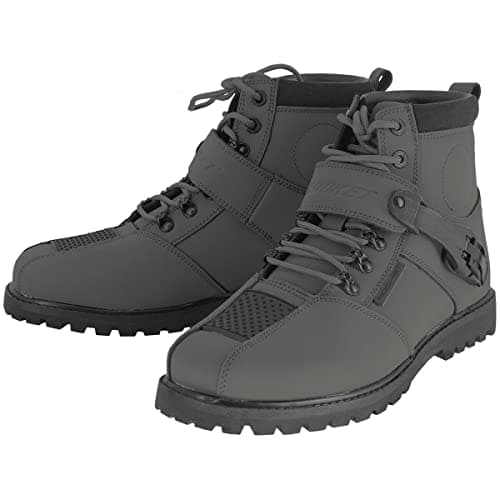
| 03 | Joe Rocket OutbreakThe value street boot: a leather riding boot with ankle support and a proper shift pad, at a price that makes wearing real boots on every ride an easy call. | Best value street boot | | $97.49·Amazon |
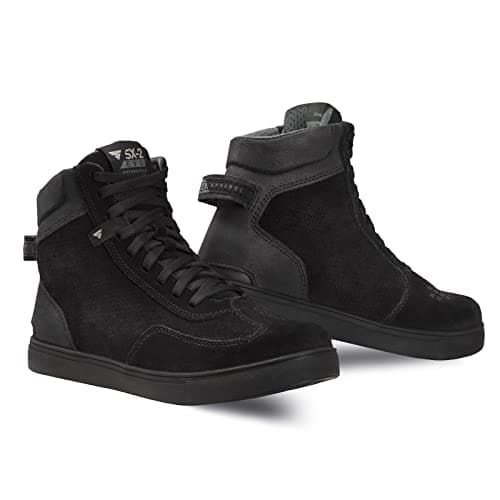
| 04 | SHIMA SX-2 EVOThe cheapest genuinely certified shoe here, and the most transparent about what that certification is worth: SHIMA publishes the full level string and every digit is a 1. That is the floor of the standard — and the floor of a real standard is still a great deal more than a fashion sneaker with a moto badge on it. | Best certified budget pick | | $139.99·Amazon |
#ad · Live prices from the Amazon Product API, as of October 19, 2026. Where we have no verified live price we show none — we would rather leave a gap than print a number that has rotted.
In detail
Best value waterproof
HiPora 3-layerDual-density ankleMX-style bucklesAnti-twist midsole
The value waterproof boot: a HiPora three-layer membrane under an Italian microfiber upper, with dual-density ankle armor and MX-style buckles, for roughly half the price of the premium pairs.
- Protection
- 8.2
- Fit/comfort
- 8.4
- Weather
- 8.8
- Walkability
- 8
- Value
- 9.2
Pros
- +HiPora three-layer waterproof and breathable membrane at a mid-budget price
- +Dual-density molded ankle protectors, TechnoGI heel cup and toe cap, reinforced shifter guard
- +Uni-directional anti-twist nylon midsole — the feature that resists an ankle rolling sideways
- +Hook-and-loop top closure fits a wide range of calf sizes
Cons
- −No CE EN 13634 class published
- −Mid-height shaft gives less shin coverage than a tall touring boot
Don't buy this if…
…you want maximum shin coverage or a stated CE class — this is the value pick, honestly labeled.
Best overall boot
EN 13634 CETall shaftAnkle armorTorsion-controlled sole
The do-most sport-touring boot: CE-certified, tall enough to guard the shin, stiff enough to resist a twist, and comfortable enough to walk in — the boot most street riders should buy.
- Protection
- 9
- Fit/comfort
- 8.4
- Weather
- 8.4
- Walkability
- 7.6
- Value
- 8.2
Pros
- +CE-certified with ankle protection and a controlled-flex sole
- +Tall shaft guards the shin and ankle without feeling like a race boot
- +Reasonably walkable off the bike
Cons
- −Pricey
- −Stiffer than a casual boot until broken in
Don't buy this if…
…you want a low, casual boot you can wear all day off the bike — this leans sport.
Best value street boot
LeatherAnkle supportOil-resistant soleShift pad
The value street boot: a leather riding boot with ankle support and a proper shift pad, at a price that makes wearing real boots on every ride an easy call.
- Protection
- 7.6
- Fit/comfort
- 8.2
- Weather
- 7.4
- Walkability
- 8.2
- Value
- 9.2
Pros
- +Real riding boot with ankle support and a durable shift pad
- +Oil-resistant, grippy sole
- +Cheap enough to be your everyday boot
Cons
- −Less armor than a dedicated sport boot
- −Not fully waterproof
Don't buy this if…
…you want maximum CE protection or a guaranteed-waterproof touring boot.
Best certified budget pick
EN 13634:2017, level 1111ArmorPlus ankle absorbersPerforated suede upperReinforced heel and toe
The cheapest genuinely certified shoe here, and the most transparent about what that certification is worth: SHIMA publishes the full level string and every digit is a 1. That is the floor of the standard — and the floor of a real standard is still a great deal more than a fashion sneaker with a moto badge on it.
- Certification
- 8.6
- Protection
- 7.6
- Weather
- 5.8
- Walkability
- 8.8
- Value
- 9.4
Pros
- +SHIMA publishes "certified according to EN 13634:2017, protection level 1111" — the complete string, which almost nothing at this price does
- +ArmorPlus impact absorbers at the ankle with TPU reinforcement, reinforced heel and toe areas, and a transversely reinforced sole
- +Perforated suede with reflective detailing and a spare set of fluo laces, at roughly half the price of the premium picks here
Cons
- −Level 1 across all four rated areas is the minimum a shoe can score and still be certified — it passes every test at the lower level
- −Perforated suede is a summer upper: no membrane, and it soaks through in sustained rain
- −EU sizing and thin per-size stock on Amazon, so the size you want may not come in the color you want
Don't buy this if…
…you ride through winter or in regular rain — this is a ventilated warm-weather shoe and it will not keep your feet dry.
The four, on what their makers publish
| Boot | Published certification | Height | Waterproof | Who it is for |
|---|
| Tourmaster Break Trail WP | None published | Mid shaft | HiPora 3-layer membrane | The default first boot |
| Alpinestars SMX-6 V3 | EN 13634 CE certified | Tall shaft | Varies by version | If you will ride a lot, soon |
| Joe Rocket Outbreak | None published | Short / ankle | No — not fully waterproof | The cheapest real riding boot |
| SHIMA SX-2 EVO | EN 13634:2017, level 1111 | Shoe height | No — perforated suede | If you will only ever wear a shoe |
The certification question, answered honestly
Two of these four publish an EN 13634 certification and two do not, and the ranking does not follow that line. That needs explaining, because on a safety-critical page the published standard usually wins.
The SHIMA SX-2 EVOpublishes the complete level string — "certified according to EN 13634:2017, protection level 1111" — which is more transparency than almost anything at its price. Every digit is a 1, the floor of the standard. It is still a real certification, and it is genuinely more than the Tourmaster can claim. But it is a shoe: perforated suede, no membrane, shoe height. For a new rider who will take one ride in the rain and one ride in traffic, the Tourmaster's membrane, mid shaft and molded ankle protectors are the more useful boot even though Tourmaster publishes no class at all, and we say so rather than letting the paperwork pick for us. If you want the paperwork to lead, buy the Alpinestars or the SHIMA.
What is not a judgment call: never buy footwear whose only claim is "motorcycle style." An uncertified riding boot with a molded ankle protector and an anti-twist midsole is engineering you can see. A sneaker with a logo on it has neither, and nobody has tested it for anything. Our EN 13634 explainer covers how to read the level string when a maker does publish one.
What a beginner does not need
- A race boot. Toe sliders, external ankle braces and a sole you cannot flex are built for a track pace. On the street they make the boot harder to walk in and more expensive, and the protection you are gaining is for crashes you are not having yet.
- Gore-Tex, on a first pair. A named premium membrane roughly doubles the price. A mid-tier membrane like Tourmaster's HiPora keeps a commute dry; our waterproof boots ranking explains what the premium actually buys if you ride through winter.
- Two pairs. One pair that fits the riding you do now beats a tall touring boot plus a shoe you bought because the boot was annoying. Add the second pair when the riding changes.
- Heated anything. Cold feet are a real problem and a solvable one later — our warm feet guide starts with socks and insoles, not with a bigger boot.
Sizing: the part that goes wrong by post
Motorcycle boots are made on European sizing and the US conversion printed on the box is approximate. Three rules save most returns. Buy by the EU number, from the maker's own chart, measured late in the day. Try them on over the socks you will ride in, because a thicker sock does not make a tight boot fit — it makes it tighter, and a boot stretches across the width and almost nothing in length. And treat a boot that only just closes at the last buckle hole or the end of the Velcro as too small: you will want that room over jeans and over a winter sock. Our boot fit guide has the full check, including instep height and calf volume, which are the two things a size number will never tell you.
Expect a break-in period on any leather or microfiber boot, and do not judge the purchase on the first ride — our boot break-in guide covers what softens with wear and what never will. When you are ready for the full field rather than the first pair, our motorcycle boots ranking and how to choose boots guide pick up where this page stops.
How we picked
Everyone in this category says they tested twenty helmets. We haven't tested any — and we say so. What we do instead: compile the published DOT, ECE 22.06 and Snell certifications, the manufacturer's fit, weight and shell specs, the CE armor levels, and reputable published reviews, then score each pick against a published rubric. The scores are judgments from documented research — not measurements we took, because we do not run a lab and we are not going to pretend we do. Every certification and spec claim traces to a source we name and link.
Questions
Can I just ride in work boots to start with?+
A tall leather work boot with a hard sole and real ankle coverage is a long way better than a sneaker, and plenty of new riders start there. What it lacks is a molded ankle protector, an anti-twist midsole and any test evidence at all. If money is the constraint, ride in the work boots and buy a certified pair when you can — that is a far better plan than riding in trainers while you save.
Do beginner motorcycle boots need to be CE certified?+
It helps and it is not the only thing that matters. A published EN 13634 level string tells you the boot was dragged, cut and crushed in a laboratory and survived; the SHIMA SX-2 EVO publishes 1111 and the Alpinestars SMX-6 V3 publishes EN 13634 certification. An uncertified boot with molded ankle armor and a reinforced toe is still real protection — just undocumented. Avoid anything whose only claim is styling.
Short boots or tall boots for a first pair?+
Mid-height, over the ankle bone, is the honest first-pair answer: enough structure to matter, little enough bulk that you keep wearing it. Tall boots protect the shin better and get left at home more often. See our
short vs tall boots guide for what each height actually covers.
How much should a first pair of motorcycle boots cost?+
Less than you think, and we deliberately do not print numbers in this prose because prices move — the live price on each card below is the real one, stamped with the date we fetched it. The useful framing: the cheapest genuinely certified options and the best value waterproof boots sit at roughly half the price of the premium sport-touring pairs, and the gap buys refinement rather than basic protection.
Will motorcycle boots fit over jeans?+
Some will. A hook-and-loop or buckle top closure with a published adjustment range will go over denim; a fitted zip shaft usually will not. The Tourmaster Break Trail's hook-and-loop top closure is specifically why it leads this page — a first boot that does not fit over the trousers you actually wear is a first boot you stop wearing.
Are riding shoes enough for a beginner?+
They are much better than sneakers and less protective than boots, and for a rider who genuinely will not wear a boot they are the right compromise. Choose a certified one — our
riding shoes ranking covers the field and names which makers publish a level string, because at shoe height that paperwork is rarer.
Receipts
We do not run a testing lab, and we do not pretend to. Our picks are built from published certifications, manufacturer spec sheets, the standards documents themselves, and reputable published reviews — named and linked above. Where we could not verify something, we say so on the page rather than quietly leaving it out. Read our full method.