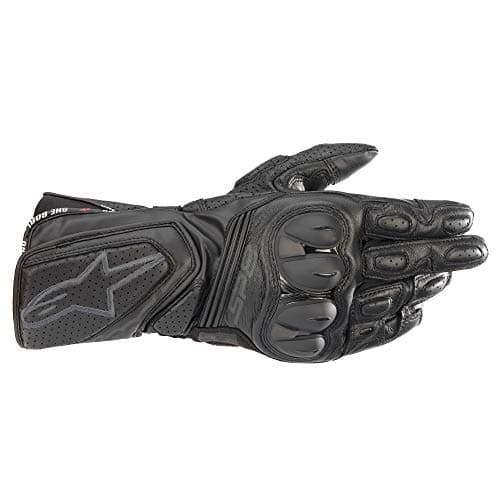
The best touring glove for most riders is the Alpinestars SP-8 V3 — a CE-certified full-gauntlet leather glove with a hard knuckle and a palm slider, whose gauntlet cuff seals over the jacket sleeve instead of leaving a gap at the wrist. It is the warm-and-dry half of a touring kit. The budget pick is the Kemimoto Leather glove, the cheapest pair here: CE-certified leather with hard knuckle armor and touchscreen fingertips, with a shorter cuff than a gauntlet and a basic palm reinforcement. We have not tested any of these gloves. Every certification and material claim below is the maker's published spec, and the prices in the table below are live Amazon figures stamped with the date they were pulled.
Here is the thing most touring-glove lists will not say: one pair cannot do a touring year.A glove warm enough for a 38°F morning in the mountains is unwearable at 95°F in the valley that afternoon, and insulation is not something you can vent your way out of. The honest answer is a two-glove system — a certified gauntlet for mild and warm riding, and a membrane glove for cold and wet — which is why this ranking contains both and tells you which is which rather than pretending one pair wins.
What makes a glove a touring glove
Four published things. One: the cuff. A gauntlet or long mid-cuff that seals over or under the jacket sleeve, because at 70 mph a wrist gap is a cold-air inlet and, in a slide, the first place a glove gets pulled off. Our short vs gauntlet comparison covers the trade in detail. Two: a published EN 13594 line.The standard grades gloves Level 1 or Level 2, with "KP" indicating certified knuckle protection — optional at Level 1, mandatory at Level 2. A spec sheet that prints "Level 1 KP according to EN 13594:2015" is telling you something specific; a bare "CE" badge is not. Three: bar feel over distance, because a glove that numbs your fingers is a safety problem, not a comfort one. Four: a membrane that actually works— GORE-TEX or Drystar, named, rather than "waterproof" as an adjective.
Everything here is a judgment from those published documents and spec sheets, scored against the rubric on our methodology page. We do not run a lab and we have not abraded a glove on a test rig. What we can do is read what the makers publish and tell you when they publish nothing — which, in this category, is often.
Building a two-glove touring kit
The warm half: the Alpinestars SP-8 V3.EN 13594 CE certification, a full gauntlet, a hard TPU knuckle and a palm-sliding reinforcement — the sport-glove construction that happens to be exactly what a touring rider wants above 60°F. The cuff runs warm in peak summer and there is a firm break-in period, both of which are in its cons. For genuinely hot touring, swap to something perforated from our summer glove ranking.
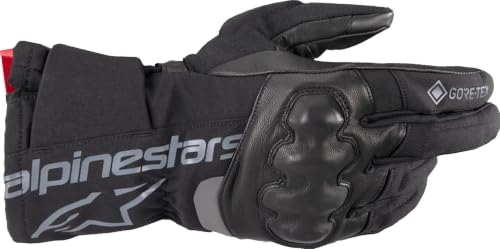
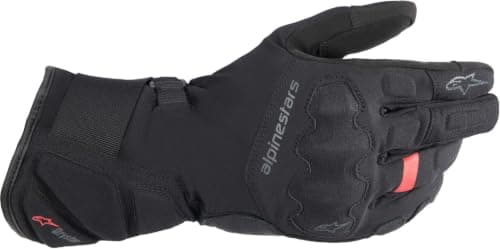
The cold-and-wet half: the Alpinestars WT-4 Gore-Tex or the Tourer W-7 V2 Drystar. The WT-4 is the deep-cold pick — genuine GORE-TEX with 80 g PrimaLoft Silver insulation and GORE GRIP construction, which is the detail that keeps bar feel when a bulky insulated glove would not, plus a mid cuff that wears over or under the sleeve. The Tourer W-7 V2 is the cold-and-wet pick: a waterproof, windproof Drystar membrane with insulation, knuckle protection and a long sealing cuff, and it keeps dexterity better than most winter gloves. Both are too warm for summer, and both say so.
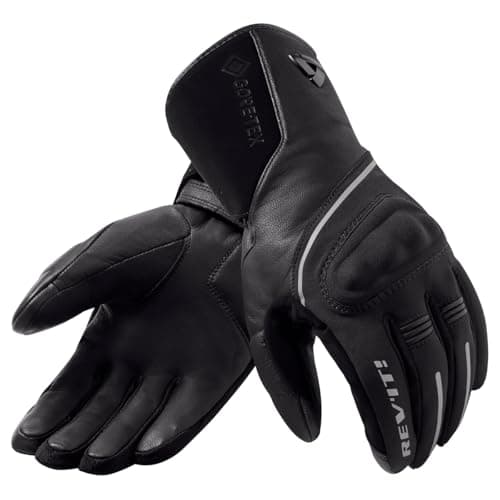
Women's touring: the REV'IT! Stratos 3 GTX.The most complete certification line on this page — "Level 1 KP according to EN 13594:2015" — over a GORE-TEX Z-liner with 3M Thinsulate G in 300 g and 80 g weights, a Temperfoam palm slider and a visor wiper. Our women's glove ranking has the wider field, including summer options on the same last.
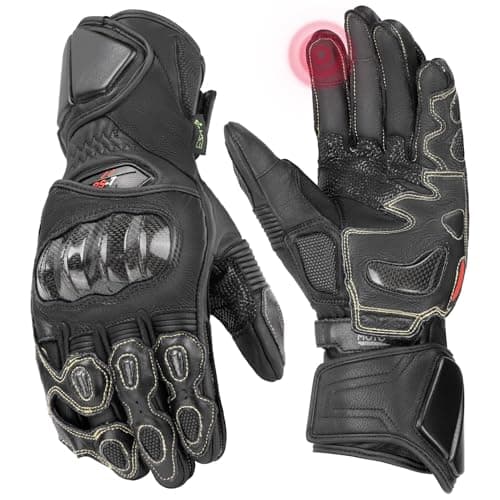
Spending the least: the Kemimoto Leather glove. CE-certified leather with hard knuckle protection and touchscreen fingertips for a fraction of a premium gauntlet. The honest limits: a shorter cuff than a gauntlet, so less wrist coverage, and a basic palm reinforcement rather than a slider.
Three things that ruin a touring glove
Buying one size too large. A loose glove spins on your hand, which moves the knuckle armor off the knuckle and puts seams where your fingers bend. Measure properly with our glove sizing guide — leather stretches, textile does not, and a new leather glove should feel firm.
Wearing the cuff on the wrong side of the sleeve. A gauntlet goes over the jacket cuff so water runs off; a short cuff goes under it so water does not run in. Getting that backwards defeats the best membrane on the market.
Trying to solve cold with insulation alone.Below about 40°F, heat put into the grips beats insulation wrapped around your fingers, because it does not cost you bar feel. Our heated grips vs heated gloves comparison works through which fix suits which bike, and heated grips are the cheaper half of that answer.
How we picked
Everyone in this category says they tested twenty helmets. We haven't tested any — and we say so. What we do instead: compile the published DOT, ECE 22.06 and Snell certifications, the manufacturer's fit, weight and shell specs, the CE armor levels, and reputable published reviews, then score each pick against a published rubric. The scores are judgments from documented research — not measurements we took, because we do not run a lab and we are not going to pretend we do. Every certification and spec claim traces to a source we name and link.