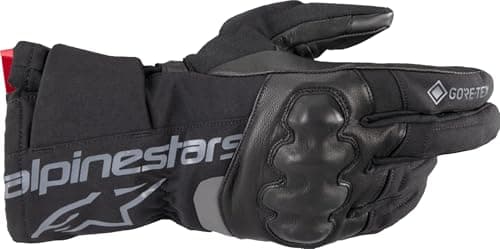
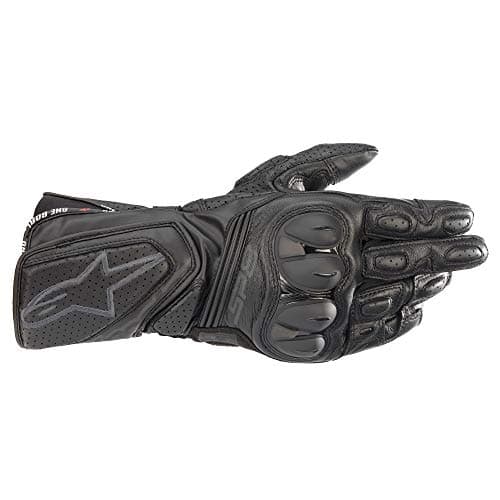
Short answer: buy leather for warm and dry riding and textile for cold and wet, and stop treating it as a safety argument. The Alpinestars SP-8 V3 is our top-ranked leather glove and the one we would hand most riders for three seasons out of four; the Alpinestars WT-4 Gore-Texis the textile answer for the fourth. If you only ever buy one pair, buy leather — most riders ride most of their miles in conditions where leather is better, and a leather glove worn year-round is a better outcome than a textile glove that is too hot from April to October.
The reason this comparison gets argued badly is that almost everyone frames it as "which material is safer." That framing is wrong, and the standard proves it. EN 13594:2015, the CE standard for motorcycle gloves, tests the finished glove— abrasion, cut, tear and seam strength, cuff length, restraint and ergonomics — and sorts it into Level 1 or Level 2. It does not mention leather. It does not mention textile. A certified textile glove has passed tests an uncertified leather glove has not, and no amount of cowhide changes that. Our EN 13594 explained guide takes the standard apart in full.
So the useful question is not which material is stronger in a laboratory. It is which material is better at the job you need done. We compared them on five:
- Abrasion and how the material fails. Both can pass the same tests. They fail differently, and that difference is real.
- Feel at the lever. Brake modulation is a safety feature. A glove you cannot feel through is a glove that costs you control.
- Weather range. This is where the two genuinely diverge, and it is the honest basis for choosing.
- Fit over time. One of these materials changes shape to your hand. The other does not.
- What the maker publishes. Same rule as every page on this site: a published level beats a material story.
We have not abraded, cut or crash-tested a glove and we do not run a lab. Everything below comes from the published standard, the test house's description of its requirements, and the makers' own specifications — all linked at the bottom.
Leather vs textile, honestly
| | Leather | Textile |
|---|
| Abrasion behaviour | Abrades gradually, tends to stay in one piece | Varies hugely by fabric; can hole suddenly |
| Feel at the lever | Best, and improves as it breaks in | Good when thin, poor once insulated |
| Hot weather | Good perforated, hot unperforated | Best - mesh panels flow more air than perforation |
| Cold and wet | Poor - soaks, stiffens, dries slowly | Best - membranes and insulation only work here |
| Fit over time | Moulds to your hand across the first weeks | Fits the way it fits on day one, forever |
| Care | Needs conditioning; killed by heat drying | Washable; membrane needs no conditioning |
| Published certification | Identical standard: EN 13594:2015, Level 1 or 2, KP mark separate |
The abrasion argument, stated accurately
Leather's reputation is earned, but not for the reason usually given. It is not that leather is mystically tougher. It is that leather is a consistent material with a well-understood failure mode: a good hide abrades gradually, loses thickness, and tends to hold together as one piece while it does. You can see how far through it has gone. That predictability is why race gear is leather and why the standard's hardest tests have historically been easiest to pass in hide.
"Textile" is not one material, and that is the real difference. It covers ballistic nylon, Cordura, Kevlar-blended weaves, stretch panels, soft shell and plain polyester, and the gap between the best and worst of those is enormous. A heavy Cordura palm will outlast a thin polyester one by an order of magnitude, and neither is described as anything other than "textile" on a product page. That variance is the honest reason to be more careful shopping textile gloves than leather ones — not because the ceiling is lower, but because the floor is.
Which is exactly why the certification matters more here, not less. A textile glove publishing EN 13594:2015 Level 1 KP has been measured; a textile glove with no published level has not. The same logic applies to leather, but a cheap leather glove is at least cheap leather. A cheap textile glove might be a gardening glove with knuckle plastic glued on.
Almost every "textile" glove is a hybrid, and the palm is why
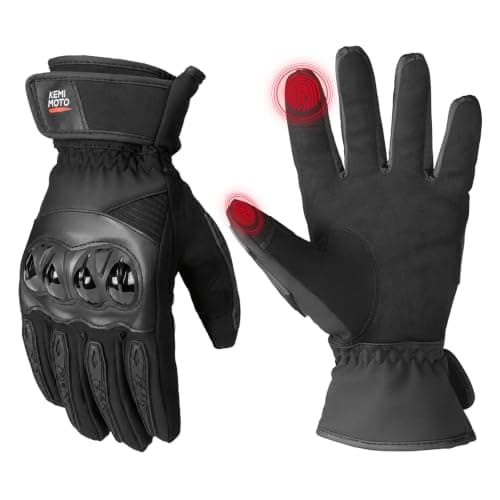
Look closely at the textile gloves on this page and you will notice they are not actually textile all over. The Alpinestars WT-4 uses a GORE-TEX construction with GORE GRIP technology at the palm; the Kemimoto winter glove puts a reinforced palm under a waterproof textile shell. That is the norm, not an exception.
The reason is that the palm is the zone that hits the ground. In almost every fall, your hands go out in front of you and the heel of the palm — over the scaphoid, the small wrist bone that breaks most often in a motorcycle crash — takes the first contact and then slides. Makers put their best abrasion material there regardless of what the back of the glove is made of, which is why a "textile" glove is usually textile where it needs to breathe or stretch and leather or a synthetic equivalent where it needs to survive.
The practical consequence for a buyer: judge a glove by its palmand its published level, not by the material of the part you can see while riding. A palm slider — a hard, low-friction patch at the heel of the hand designed to let the glove skid rather than grab — matters more than either material, because the injury it prevents is the one that happens when a glove grips tarmac and your wrist keeps rotating. Our how to choose gloves guide covers what to look for zone by zone.
Weather is the real dividing line
Here is where the two materials genuinely separate, and it is the basis we would actually choose on.
Leather is bad in the wet. Untreated hide absorbs water, gets heavy, goes cold against your skin, stiffens as it dries and can shrink if it dries too fast near a heater. A soaked leather glove is miserable for the rest of the ride and still damp the next morning. Leather also has no way to carry a waterproof membrane without becoming a hybrid.
Textile owns cold and wet for a structural reason. A waterproof-breathable membrane has to be laminated or bonded between layers, and insulation has to be lofted between layers. Both need a multi-layer construction that textile gives you and a single hide does not. That is why every winter glove we rank is textile or a textile hybrid, and why the Alpinestars WT-4 can publish GORE-TEX with 80 g of PrimaLoft insulation while no all-leather glove does.
In real heat, textile usually wins too, which surprises people. A perforated leather glove flows air through punched holes; a mesh-panelled textile glove flows it through open weave, which moves considerably more. The catch is that hot-weather textile gloves are often the thinnest, least abrasion-resistant gloves a brand makes, so this is exactly where the published level earns its keep. Our summer gloves ranking and winter gloves ranking handle the two ends properly.
There is one honest observation from our own catalog worth stating: across the gloves we rank, everytextile glove is a cold-weather or wet-weather glove and every warm-weather pick is leather. We did not plan that. It is what the market produces, because the conditions where textile's advantages matter most are the cold and wet ones.
Fit: the one thing leather does that textile cannot
A leather glove breaks in. Over the first few weeks the hide stretches across the width, softens at the knuckles and finger joints, and ends up shaped like your hand. That is genuinely valuable, because a glove moulded to you moves with your fingers instead of bunching against the lever, and brake feel improves measurably as it happens.
It also sets the buying rule: a new leather glove should be snug, verging on slightly tight across the palm, with no loose material in the fingertips. Buy a leather glove that feels perfect in the shop and it will be sloppy in a month.
Textile does none of this. It fits on day one the way it will fit in year three, which means you must buy the correct size immediately and there is no breaking in a bad purchase. Our glove sizing guidecovers measuring your hand, and the rule it gives — never size up "to be safe" — applies doubly to textile.
Care, which decides how long either lasts
Leather needs conditioning once or twice a season and will crack if you let it dry out. The thing that destroys leather gloves fastest is heat drying: a radiator or a hairdryer cooks the oils out and leaves the hide brittle and shrunken. Wet leather gloves dry at room temperature, away from heat, ideally with something inside them to hold the shape.
Textile is mostly washable and needs no conditioning, but a membrane glove must not be dried hot either, and fabric softener will clog a membrane permanently. Insulation also packs down over time, so a five-year-old winter glove is a colder glove than it was new even if it looks fine.
Either way, gloves are consumables. They are the gear item most exposed to sweat, rain, UV and friction, and the stitching at the fingers is usually what goes first. Check the seams and the palm every few months — a split seam at the thumb web is the start of a glove coming apart in exactly the place you need it not to.
So which should you buy?
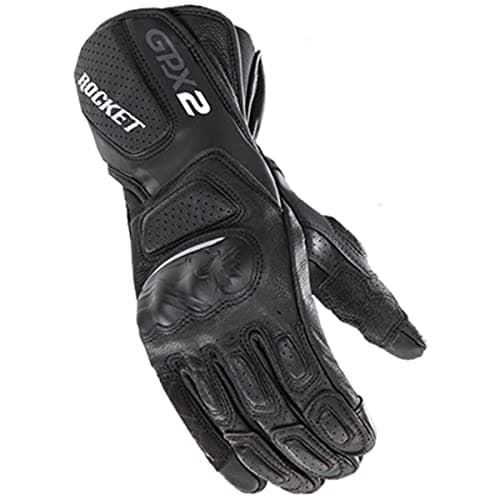
Buy leather if you are buying one pair. Most riding happens in dry weather above 50°F, leather is better in all of it, and a perforated leather glove handles summer acceptably. The Alpinestars SP-8 V3 is our pick: a full-gauntlet leather glove with a hard knuckle, a palm slider and a published EN 13594 CE certification, and it is the top pick on our main gloves ranking for the same reasons. The Joe Rocket GPX 2.0 is the short-cuff goatskin alternative if a gauntlet is more glove than your riding needs.
Buy textile when the weather is the problem. The Alpinestars WT-4 Gore-Tex is the one we rank for genuine cold: GORE-TEX, 80 g PrimaLoft and GORE GRIP at the palm, which is a package no leather glove can assemble. The Kemimoto Winter is the budget version of the same idea, and its card is honest that it publishes no EN 13594 level.
Buy both if you ride year-round, and most riders eventually do. A leather pair for three seasons and a textile winter pair is the normal end state, and it costs less than you think because neither pair wears out as fast when it is only doing the job it is good at. Before you spend, read our short vs gauntlet comparison — cuff length changes the answer more than material does — and our EN 13594 guide so you can read what a maker is and is not claiming.